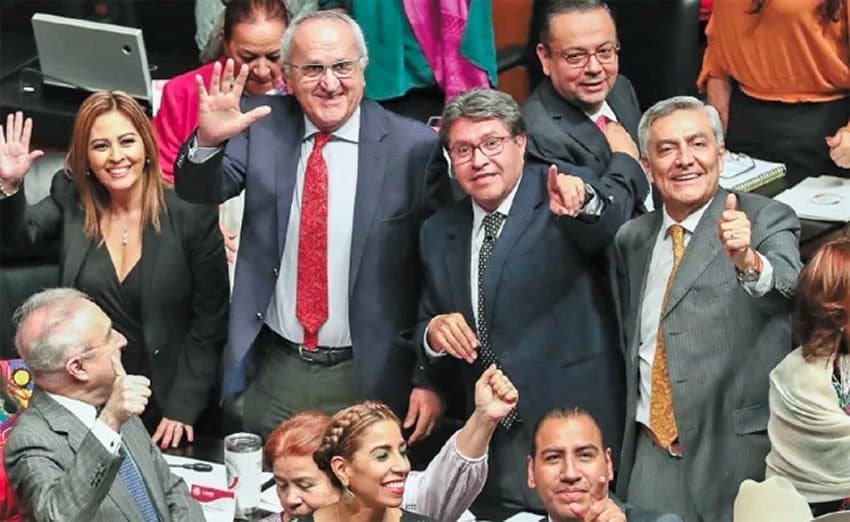
The Senate yesterday approved the new North American trade agreement, making Mexico the first country to ratify the deal that will replace the 25-year-old NAFTA.
Senators voted 114 to four in favor of the United States-Mexico-Canada Agreement (USMCA), which was signed by the leaders of the three countries last November.
President López Obrador congratulated lawmakers in a video posted to social media and described the ratification as “very good news” for Mexico.
“. . . The majority of lawmakers from all of the country’s parties voted [in favor]. That means there is unity, that we’re in agreement with strengthening our relationship with the United States and Canada. We’re opting for, we’re choosing free trade. We don’t have any doubt,” he said, neglecting to mention that three Morena senators voted against ratification.
The president said the agreement will bring foreign investment to Mexico, generate jobs and guarantee a market for Mexican products in the United States, “with the bonus that there will be well-being in our country, with the bonus that there will be justice in our country.”
“It’s balance, growth with well-being, progress with justice because progress without justice is a backward step. That’s why I’m very pleased that this treaty has been ratified, with all respect, we’re ahead of Canada and ahead of the United States . . .” López Obrador said.
The Business Coordinating Council, a leading business organization, said that ratification of the trilateral pact would help generate investor certainty, better opportunities for workers and favorable conditions for the development.

United States President Donald Trump, who repeatedly threatened to withdraw from NAFTA during a contentious and drawn-out negotiation to reach the new pact, congratulated López Obrador for Mexico’s approval and said that it’s “time for Congress to do the same here!”
Once ratified by the United States and Canada, the USMCA will enter into force and remain valid until 2035 unless it is renegotiated.
Canada is moving ahead with its ratification process but Democratic lawmakers in the United States have threatened to block its passage. Speaker Nancy Pelosi said yesterday that she still has many concerns about the USMCA.
However, U.S. Trade Representative Robert Lighthizer said he believed that concerns about the enforcement of labor and environmental provisions in the agreement can be resolved quickly.
Mexico’s lower house of Congress approved a landmark labor reform package in April that was considered crucial for the ratification of the trade deal in the United States.
The updated three-way trade pact includes new chapters on anti-corruption measures, labor and digital trade, and stipulates new rules for telecommunications, small and medium-sized businesses, intellectual property, competitiveness and the environment.
Mexico also agreed to establish high-wage areas where auto-sector workers will earn at least US $16 per hour.
Under the terms of the USMCA, new cars must have at least 75% regional content in order to qualify for tariff-free access to the North American market.
Source: El Universal (sp), Reuters (en)