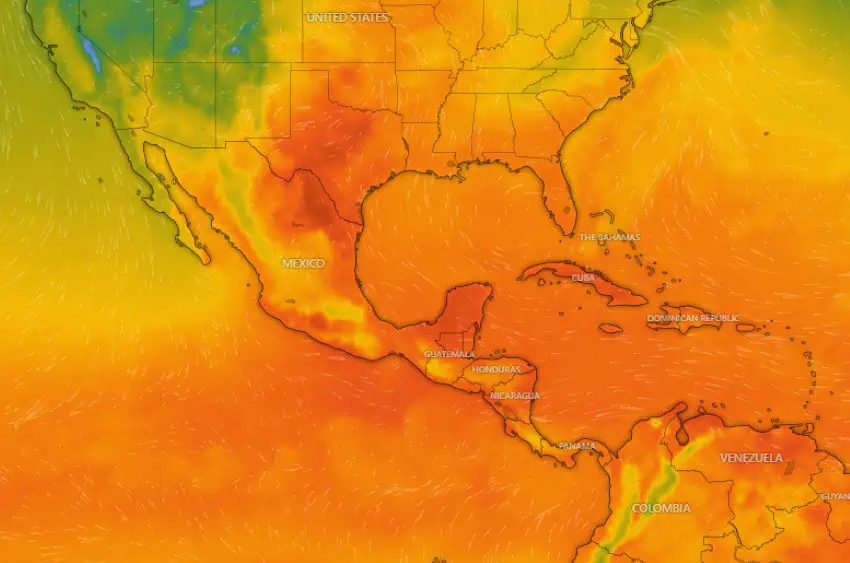
Mexico is warming up faster than the rest of the world, according to researchers at the National Autonomous University of Mexico (UNAM).
In an article recapping the recent event Climate Change in Mexico: Trends, Risks and Policies, the institution noted that temperatures in Mexico have risen by 1.8 degrees Celsius from the pre-industrial period (before 1800) to 2024. That increase is more than the global average of 1.5 degrees Celsius, which itself inched slightly higher last year, the hottest year on record globally (and an especially torrid one in Mexico).

“We’re warming up faster than the global average with a greater warming rate,” the UNAM article said.
That 1.5-degree increase over pre-industrial global temperatures is the threshold set by the Paris Climate Agreement in 2015. Yet according to Francisco Estrada Porrúa, senior climate researcher at UNAM, Mexico has seen average warming above that figure for the last year and a half. Estrada mentioned that Mexico also surpassed the average 1.5°C mark in 2016, 2017 and 2020.
The trend has real-life consequences. In 2006, Estrada and his team predicted that coffee production in Veracruz would register an estimated 24% loss in 2020 due to climate change. Now, the estimate is around 48%.
“This only indicates how serious the consequences of [climate change] are,” the UNAM article noted.
Naxhelli Ruiz Rivera, chair of the Seminar on Socioenvironmental Risks of the UNAM’s Geography Institute said that climate-related social risks should go hand-in-hand with social rights. She noted that there are 35.3 million homes in Mexico with serious deficiencies in the face of climate change, including dampness or leaking foundations.

In November 2024, the country saw the relocation of its first climate refugees.
The families of El Bosque, a fishing community in the southern state of Tabasco, were relocated to new homes after rising sea levels swallowed their land. The state government officially recognized them as relocated “due to climate impact,” and the federal government provided them with 51 homes. By January this year, 60 families had been relocated with 20 others pending relocation.
In general, northern states (Coahuila, Chihuahua, Sonora, Durango) show the highest average rises in temperature in all seasons of the year, while the Yucatán and the Baja California peninsulas exhibit the least warming (except in winter).
With reports from El País