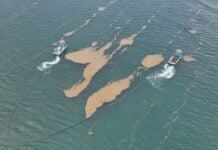
Scientists from Mexico and Japan have deployed deep-sea instruments off Oaxaca’s coast to better understand earthquake and tsunami risks in a region where seismic energy is believed to be building.
Researchers from the National Autonomous University of Mexico (UNAM), Mexico’s National Center for Disaster Prevention (Cenapred), the Navy, and universities in Kyoto and Tohoku placed eight ocean-bottom seismometers and three pressure gauges more than 5,000 meters below the Pacific Ocean’s surface near the tourist destination of Huatulco.
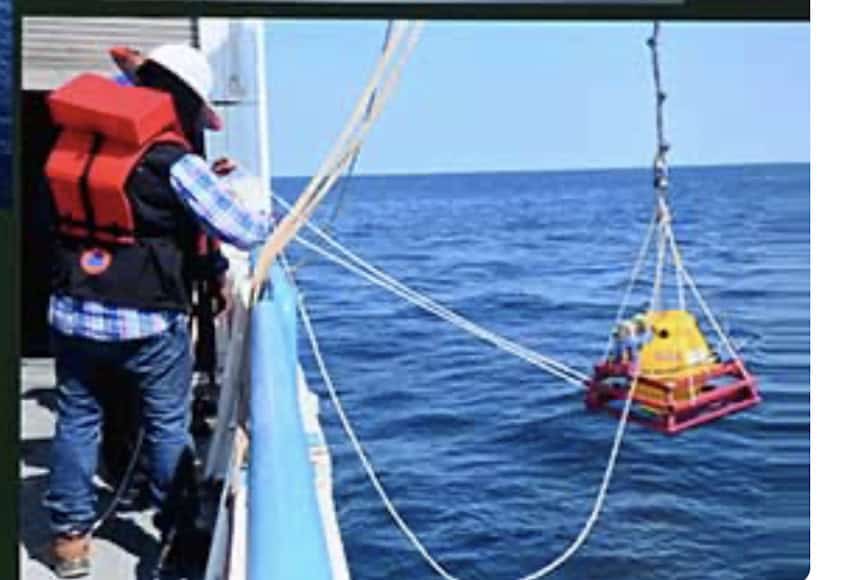
The devices will collect data for a year on slow-slip events linked to major quakes.
UNAM geophysicist Víctor Manuel Cruz Atienza said the offshore segment off Huatulco has not recorded a major earthquake since 1978, despite evidence of slow displacements and significant energy accumulation. The area is designated a seismic “gap,” according to the journal Science.
“Thanks to ocean-bottom seismometers and new tools, including machine learning, we’re finding low-frequency seismic activity offshore that wasn’t listed” in any previous databases, Professor Yoshihiro Ito of Kyoto University said in a UNAM press release. “The seabed is telling us that more is happening down there than we could see on land.”
Added Cenapred director Enrique Guevara Ortiz: “To reduce risks and benefit the population, it is necessary to understand what we are facing.”
The effort is part of the SATREPS program involving Mexico, Japan and El Salvador, aimed at improving hazard models, evacuation planning and disaster response along the Pacific Coast —as well as feeding back into Japan’s own hazard understanding.

Launched by the Japanese government in 2008, the Science and Technology Research Partnership for Sustainable Development supports joint research with developing countries on global issues such as disasters, climate and health.
UNAM announced this specific SATREPS project with Japan and El Salvador in late 2024 as a five-year effort focused on large earthquakes and tsunamis, backed by about US $800,000 a year in Japanese funding.
Though the shallow offshore segment under study had only one large earthquake since 1931, Oaxaca endured a magnitude 7.4 temblor in 2020 that caused about 10 deaths and damaged thousands of homes. Its epicenter was 23 kilometers south of La Crucecita, a town in the Huatulco municipality.
With reports from Publimetro