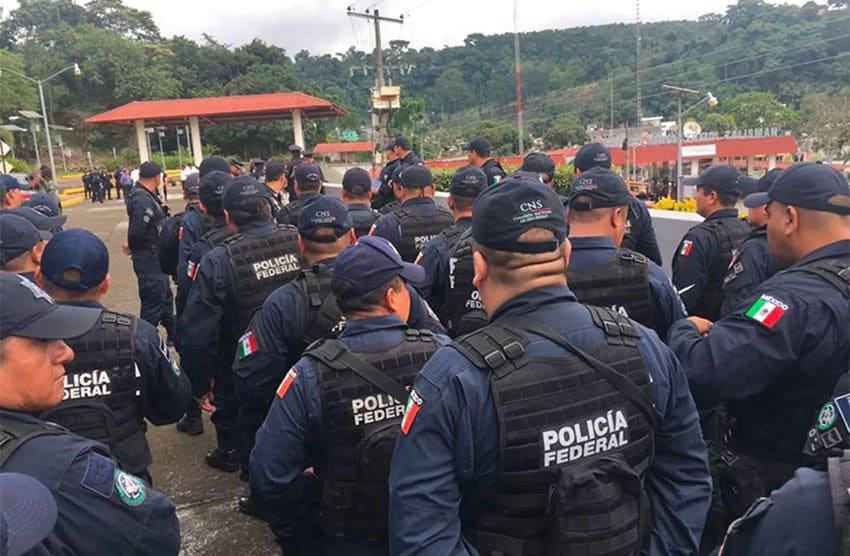
Mexico has pledged to deploy up to 6,000 National Guard troops to the southern border in an attempt to reach a deal to avoid a tariff on all exports to the United States, The Washington Post reported.
Mexican officials told United States government representatives in Washington today that the large security deployment will bring an immediate reduction to the large number of Central Americans traveling through Mexico to the U.S. border.
Foreign Secretary Marcelo Ebrard is leading a Mexican delegation in talks with White House officials aimed at reaching an agreement to prevent escalating tariffs announced by President Donald Trump last week.
The U.S. president said that 5% blanket tariffs will be imposed on June 10 and that the duties will increase by an additional 5% at the beginning of subsequent months if Mexico doesn’t take “action to dramatically reduce or eliminate the number of illegal aliens crossing its territory into the United States.”
According to the Post, Mexican officials said that 10 National Guard contingents of 450 to 600 troops each will be assigned to the border with Guatemala by September. The deployment would represent a fourfold increase on the 1,500 federal forces currently patrolling the border.
A further three units will be deployed to the Isthmus of Tehuantepec in southern Mexico to set up roadblocks and checkpoints to stop the movement of migrants.
“That’s a remarkable and significant commitment of resources beyond what they’ve previously dedicated to countering human smuggling,” an unnamed U.S. official said.

However, there was also pushback from the United States during today’s meeting, the Post reported.
Mexican officials said that its increased security measures would reduce migration to levels seen last fall when arrests of undocumented migrants in the United States averaged 60,000 per month.
But U.S. officials said the White House will only be happy when monthly arrests fall to less than 20,000, as occurred in the first months after Trump took office in January 2017.
In addition to discussions about border security in Mexico, both a Mexican and a U.S. official told the Post that the two countries are negotiating a plan to overhaul asylum rules across the region.
Under the plan, Central Americans would be required to seek asylum in the first country they reach after leaving their homeland, meaning that the United States could deport Guatemalans who enter the U.S. to Mexico, and Hondurans and Salvadorans to Guatemala.
Mexico has said repeatedly that it will not enter into such a “Safe Third Country” arrangement as the United States has with Canada, but the unnamed Mexican official said the government is prepared to make changes in order to have a coordinated regional approach.
But he said Mexico would withdraw the offer if Trump goes ahead with his plan to impose the tariffs.
The Post said the asylum notifications would likely face challenges in United States courts but noted that legal efforts had not stopped the Trump administration from returning thousands of Central Americans to Mexico as they await the outcome of their asylum claims in the U.S.
The two officials stressed that a deal between the two countries is not finalized and warned that even if one is reached, Trump might not accept it. However, they both expressed optimism that an agreement was attainable.
Talks are to continue tomorrow.
Arrests of undocumented migrants in Mexico have significantly increased in recent months but in the same period the number of migrants apprehended by U.S. Customs and Border Protection (CBP) has also risen substantially.
Trump railed against the arrest numbers for May on Twitter yesterday – at more than 144,000, CBP said that they were the highest in 13 years – and told reporters in France today that “we’ve told Mexico, ‘the tariffs go on.’ And I mean it too.”
However, there is doubt that the tariffs can be introduced as quickly as the U.S. president has announced.
The Pacific Coast Council of Customs Brokers and Freight Forwarders Association said in a letter to the U.S. government that introducing the new duties by “June 10 or even before the increase planned for July 1” will be impossible.
The council also said it felt “grave concern, even alarm” at the prospect of the tariffs taking effect.
Approximately 406,000 jobs will be lost in the United States if Trump goes ahead, according to the Perryman Group, a Texas economic consultancy, and the tariffs will also hit the Mexican economy hard.
The threat of their imposition has already taken a toll on stocks, oil, the peso and economic growth forecasts and ratings agency Fitch yesterday downgraded Mexico’s sovereign rating to one notch above junk status.
Source: Washington Post (en), CNBC (en)