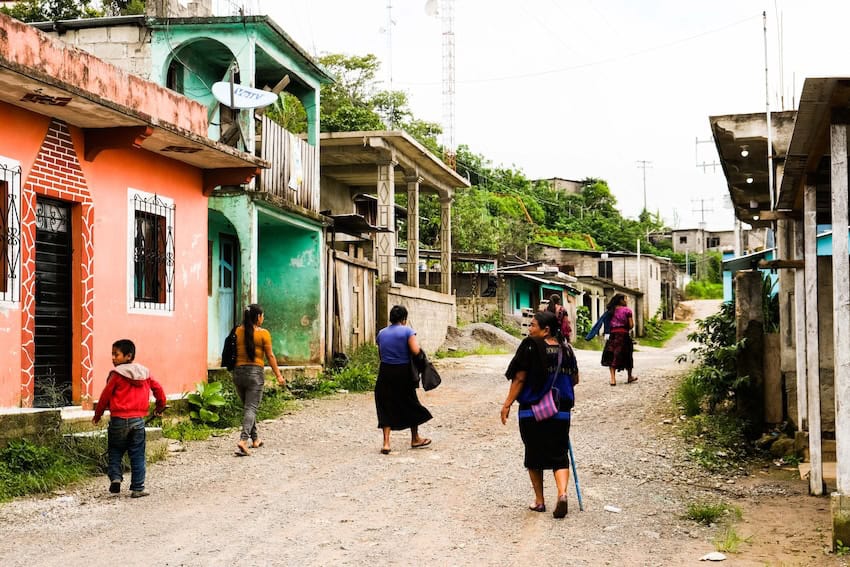
While President Claudia Sheinbaum lauded a report indicating a significant reduction in poverty since 2018, a breakdown of the figures demonstrates that southern Mexican states are lagging behind their northern brethren.
Mexico’s national statistics agency INEGI this week released its first survey measuring multidimensional poverty and Sheinbaum noted that “more than 13 million people were lifted out of poverty” between 2018 and 2024.
Poverty reduction and a major arrest: Thursday’s mañanera recapped
The multidimensional poverty index aims to calculate poverty beyond household income. It also considers access to health services, education, housing and food.
The number of people living in poverty declined from 51.9 million in 2018 to 38.5 million (29.6% of the population). Of those, 7 million (5.3% of the population) remained in extreme poverty in 2024. Most of them — nearly 4 million people — live in six southern states: Chiapas, Guerrero, Oaxaca, Veracruz, Tabasco and Campeche.
While a September 2023 report indicated that southern states — a region comprising Mexico’s poorest and least developed states — were enjoying greater economic growth than some northern counterparts, the newest poverty data indicates there is still work to be done.

While the population deemed to be living in poverty decreased in all 32 states between 2018 and 2024, the decline was uneven.
In the northern states of Baja California, Colima, Coahuila, Sonora, Sinaloa, Tamaulipas and Chihuahua, the decrease was more than 40%.
In contrast, Chiapas was the state with the smallest decrease in poverty from 2018 through 2024 — just 7.2%. It was followed in ascending order by Tlaxcala (9.9%), Guerrero (12%) and Oaxaca (14.4%).
The five states with the lowest percentages of people living in extreme poverty are all in northern Mexico: Baja California (0.4%), Nuevo León (0.5%), Aguascalientes (0.6%), Coahuila (0.8%) and Colima (1.0%).
The four states with the highest percentages of people living in extreme poverty in 2024 were Chiapas (27.1%), Guerrero (21.3%), Oaxaca (16.3%) and Veracruz (8.8%).
These four states also feature the highest percentage of its population living in multidimensional poverty: Chiapas — 3.9 million, or 66% of its population; Guerrero — 2.1 million, or 58.1%; Oaxaca — 2.2 million, or 51.6%; and Veracruz — 3.6 million, or 44.5%.
Likewise, the INEGI report showed that multidimensional poverty decreased more rapidly in urban areas (from 34.5 million to 25.5 million) than in rural areas (from 17.4 million to 13 million).
INEGI’s inaugural poverty survey
This is INEGI’s first survey measuring poverty since mandated to do so by a Dec. 20, 2024, constitutional reform that took effect last month.
The stated objective of the reform is to provide a more accurate picture of the country’s social development so as to better formulate, implement and monitor public policy.
The reform was not approved without controversy as it also eliminated the agency known as the National Council for the Evaluation of Social Development Policy (Coneval), transferring its duties to INEGI.
Coneval was established in 2005 to evaluate the effectiveness of social development policies and programs in Mexico.
Opponents of the reform insisted that Coneval provided reliable and objective information to policymakers and the public about the state of social policies, poverty and social development actions.
However, when Coneval contradicted the narrative favored by President Andrés Manuel López Obrador (2018-2024) or denounced his austerity policies, López Obrador criticized the agency.
López Obrador replaced Coneval’s director in July 2019 and suggested eliminating the agency in January 2024. He then fashioned the reform that effectively stripped the agency of its independence.
It is now managed by INEGI, which is directed by López Obrador’s former finance minister, Graciela Márquez.
Last month, former Coneval director Gonzalo Hernández said the new agency lacks credibility, accusing the government of insufficient transparency and accountability.
With reports from El Economista and La Jornada