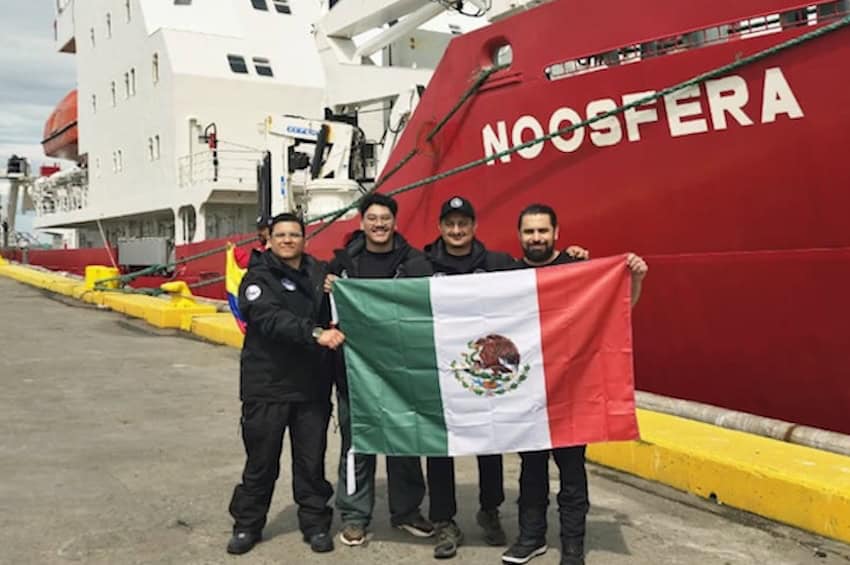
Though Ukraine has its hands full at home, the war-torn nation still has enough resources and initiative to help Mexico launch its first scientific campaign in Antarctica.
The new campaign, CAMEX-1, marks Mexico’s debut in Antarctica’s international research network — in which Ukraine has been an established player for three decades.

The Research and Assistance Center in Technology and Design of the State of Jalisco (CIATEJ) and the Mexican Agency for Antarctic Studies (AMEA) are leading the five-year initiative in collaboration with Ukraine’s National Antarctic Scientific Center.
The CAMEX-1 team has been invited to conduct research aboard the Ukrainian icebreaker Noosfera and at the Vernadsky Station, where Ukraine has carried out climate and atmospheric monitoring on the Antarctic Peninsula since 1996.
Eight Mexican researchers set sail from Punta Arenas, Chile, on Jan. 31 aboard the Noosfera, bound for what AMEA termed a “milestone for national science and international cooperation.”
“This campaign will generate key knowledge for understanding life in extreme conditions and addressing global environmental challenges,” said Lorena Amaya Delgado, CIATEJ’s general director.
The mission — which consolidates Mexico’s integration into the Scientific Committee on Antarctic Research (SCAR) — includes projects focused on biodiversity, geology, microbiology, climate change and biotechnology.

Findings could aid in developing new antibiotics and forecasting climate impacts on Mexico’s coasts, said AMEA President Patricia Valdespino, emphasizing the global effects of climate changes in Antarctica.
“What happens in Antarctica doesn’t stay in Antarctica,” she said, referencing phenomena such as rising sea levels that could lead to flooding and saltwater intrusion in coastal areas.
Valeriy Olefir, counselor of economic affairs at the Ukrainian Embassy in Mexico, called the effort “an important milestone in scientific cooperation,” adding that Ukraine is committed to expanding ties “in the scientific and technological fields.”
AMEA director Pablo Gerardo Torres Lepe said Mexico’s participation in Antarctica is part of a long-term plan to “prepare the country for climate change.”
“This collaboration,” he said, “is not only scientific — it’s about strengthening our future.”
With reports from La Jornada, La Crónica and ITV Patagonia