A new poll published this week found that 40% of U.S. voters consider Mexico a good neighbor, while 28% say it’s a bad one. That’s not a terrible headline for Mexico, until you note that its net favorability score among Americans has fallen 16 points since last spring, with cartel activity, fentanyl and unauthorized migration topping the list of U.S. grievances.
The findings arrive at an instructive moment in the bilateral relationship. USMCA negotiations are underway, and the mood music has been notably warmer than the rhetoric coming from the White House: Last week, U.S. Ambassador Ronald Johnson told the American Chamber of Commerce that the treaty review is “an opportunity to deepen integration,” not a risk. He also applauded the “historic” security cooperation by the Trump and Sheinbaum administrations.
Domestically, the week of March 23–27 delivered economic and political friction that touched on everything from the cost of borrowing to the cost of governing.
Didn’t have time to follow the news this week? Here’s what you missed.
China threatens to hit back over Mexico’s tariff hikes
Trade tensions between Mexico and China escalated sharply this week after Beijing declared it has the right to retaliate against the tariffs Mexico imposed on more than 1,400 Chinese products at the start of the year. China’s Ministry of Commerce, following a formal probe, determined that Mexico’s duties — ranging up to 50% and affecting more than US $30 billion in Chinese exports — constitute trade and investment barriers.
The ministry said losses to China’s mechanical and electrical sectors alone could reach $9.4 billion, with the automobile and auto parts industries bearing the brunt.
In a pointed response, Economy Minister Marcelo Ebrard insisted Mexico was within its rights to protect domestic industries in textiles, footwear and steel, and denied that U.S. pressure had anything to do with it, though the duties are widely seen as a goodwill gesture ahead of the ongoing USMCA review.

China, whose goods exported to Mexico dwarfed Mexico’s exports to China by a ratio of roughly 13 to 1 in 2025, could seek dialogue, escalate to the World Trade Organization, or impose retaliatory measures on Mexican goods. However, Mexico’s relatively small export footprint in China limits Beijing’s leverage.
Banxico cuts rates despite rising inflation — and the peso pays
The Bank of Mexico’s board voted 3-2 on Thursday to cut its benchmark interest rate by 25 basis points to 6.75%, even as annual headline inflation climbed to 4.63% in the first half of March — its highest level since 2024.
The board cited weak economic activity, the exchange rate and the level of monetary restriction already in place. Banxico acknowledged that inflation risks remain tilted to the upside, and raised its forecasts for three of the four quarters of 2026, but maintained that headline inflation will converge to its 3% target by Q2 2027.
Markets reacted swiftly. The peso slid past 18 per US dollar on Friday morning for the first time since early December, pressured by the surprise cut, a stronger US dollar and geopolitical risks tied to the Middle East conflict. The currency was trading at roughly 18.12 per dollar on Saturday morning.
Sheinbaum faces further setbacks to electoral reform
After last week’s defeat in the Chamber of Deputies — where her coalition allies in the Green Party and Labor Party defected — President Sheinbaum came back this week with a recalibrated approach to electoral reform. Her new strategy avoids constitutional amendments, which require a two-thirds supermajority, in favor of changes to secondary legislation that need only a simple majority to pass.
The Senate approved a version of the bill on Wednesday, but not without further trimming it. The provisions that survived focus on reducing what Sheinbaum characterized as excessive perks for lawmakers at all levels of government and for National Electoral Institute officials: eliminating special bonuses for electoral councilors, capping municipal councils at 15 members and limiting state legislature budgets to 0.7% of their state’s total budget. Savings from those cuts are to be redirected to health care, education and welfare programs. The federal Senate’s own budget is also slated for a reduction under the bill.
What didn’t survive the Senate vote was a provision that would have allowed a presidential recall election to be held concurrently with municipal, state and federal elections in 2027. Sheinbaum suggested at her Thursday press conference that her own Labor Party allies killed it out of fear that running the recall alongside legislative races would boost Morena at their expense.
The stripped-down bill still needs to clear the lower house of Congress, where the original constitutional reform failed earlier this month. Whether Sheinbaum’s coalition holds together for this softer version remains the central political question heading into next week.
Ceci Flores finds her son after 7 years of searching
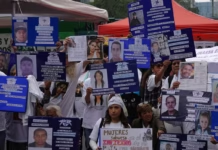
In one of the week’s most emotionally resonant stories, Ceci Flores — the founder of the search collective Madres Buscadoras de Sonora — announced that she had found what she believes are the remains of her son Marco Antonio alongside Highway 26 near Hermosillo, seven years after his disappearance.
After 7 years, renowned search collective founder Ceci Flores finds her son’s remains in Sonora
Flores identified the site partly through clothing found at the location; DNA analysis is pending. Marco Antonio went missing in 2019 when an armed group abducted him along with another brother. Flores’s collective, which she founded in 2019, has now been involved in recovering more than 2,700 bodies and reuniting 2,400 living people with their families.
The personal milestone arrived against the backdrop of a broader national reckoning. On Friday, President Sheinbaum presented a landmark government report on Mexico’s missing persons crisis, revealing that 132,534 people remain officially listed as disappeared, the vast majority of them registered since 2006.
Authorities claim they have discovered evidence of legal activity — tax filings, phone records and other traces — for more than 40,000 of those individuals, leading to the reclassification of 5,269 as located alive. However, investigations into more than 46,000 cases have not yet begun due to incomplete data. Critics, including the NGO Causa en Común, questioned whether the data fully reflects a crisis that shows no signs of slowing.
Rare school shooting in Michoacán leaves 2 teachers dead
A 15-year-old student killed two teachers at a high school in the Pacific coast city of Lázaro Cárdenas, Michoacán, on Tuesday morning, in a shooting that President Sheinbaum addressed directly at her Wednesday press conference.
The victims, María del Rosario, 36, and Tatiana Bedolla, 37, were both teachers at the private Antón Makárenko High School. The alleged perpetrator was detained at the scene; he reportedly gained access to an AR-15 rifle and opened fire after initially being blocked from entering the campus.
President Sheinbaum addressed the shooting at her Wednesday morning press conference, calling it “very painful in many senses.” She noted that the victims appeared to have been deliberately targeted, and said her government was determined to treat the attack as an “isolated incident that is not repeated.” To that end, she announced plans to expand a mental health program already operating in some middle schools to a wider audience of students the same age as the alleged shooter.
Gulf of Mexico oil spill: Cover-up accusations mount
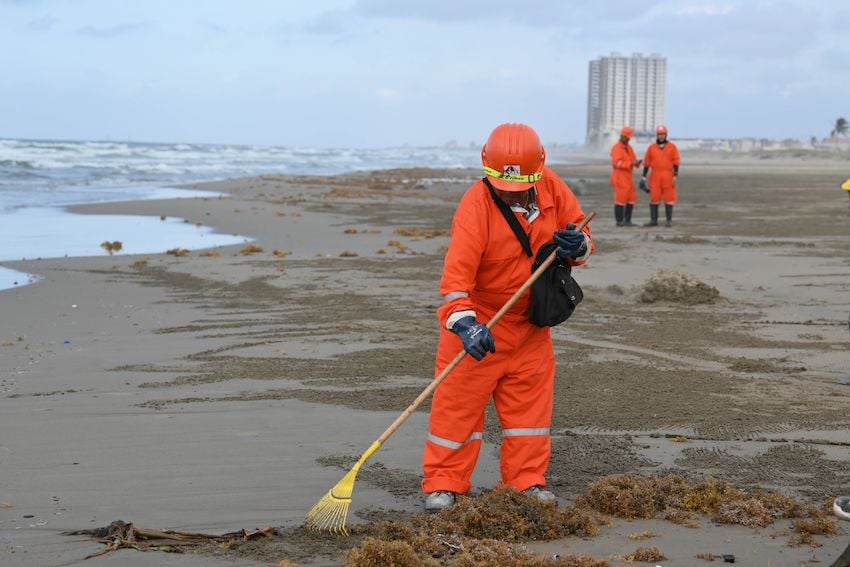
The Gulf of Mexico oil spill that reportedly began in early February continued to generate controversy this week as more than a dozen environmental organizations, led by Greenpeace and the Mexican Center for Environmental Law (Cemda), publicly accused the government of concealing the disaster’s scope and timeline.
The aerial images they presented suggest the spill originated near Pemex’s Abkatún platform as early as Feb. 6, with containment vessels visible by Feb. 13 — weeks before officials publicly acknowledged the problem.
The slick has now spread across roughly 600-700 kilometers of Gulf of Mexico coastline, affecting the Veracruz Coral Reef System and six other protected natural areas. President Sheinbaum disputed claims of a major catastrophe and accused Greenpeace of spreading an “unscientific” infographic — though the organization had already clarified the image was illustrative, not satellite-based.
Pemex denied responsibility, and the privately owned vessel initially blamed by Veracruz Governor Rocío Nahle was cleared following inspection.
Economy minister inaugurates joint forum of binational trade chambers
On Monday, Economy Minister Marcelo Ebrard inaugurated the first Forum of Binational Trade Chambers in Mexico, uniting over 20 Mexico-based trade chambers that represent companies from Argentina, Australia, New Zealand, Belgium, Brazil, Chile, France, Germany, Ireland, Israel, Italy, Japan, the Netherlands, Spain, Switzerland, the United Arab Emirates and the United Kingdom, among others.
The forum, organized with significant input from India’s Embassy in Mexico, is designed to align the collective market intelligence of its member chambers with the priorities of President Sheinbaum’s Plan Mexico economic initiative. Ebrard used the occasion to signal that the government sees international trade partnerships as central to its nearshoring and investment ambitions, and announced plans to visit India as bilateral trade grows.
Infantino in Guadalajara: World Cup is on
FIFA President Gianni Infantino traveled to Guadalajara’s Akron Stadium on Thursday night to personally watch Jamaica defeat New Caledonia in a World Cup qualifying match before nearly 41,000 fans.
His presence — just 34 days after violence in Jalisco following the killing of cartel leader El Mencho — was a pointed signal of FIFA’s confidence in Mexico as host country. The game went off without incident, and Infantino is set to meet with President Sheinbaum on Monday to review World Cup preparations ahead of the June 11 kickoff at Azteca Stadium.
Good news of the week
⚖️ Mexico’s Congress passed a new anti-femicide law that broadens the legal definition of femicide and increases prison sentences — a significant step in the country’s long fight against gender-based violence, and one that carries added resonance given the incel-linked school shooting in Michoacán earlier in the week.
🌊 Two power plants near La Paz were fined for polluting the coastal city’s air, a rare enforcement action celebrated by local environmental advocates.
🕌 A Mexican artist is working to finish Antoni Gaudí’s vision of the Sagrada Família in Barcelona, contributing to one of architecture’s most anticipated completions.
🐆 Camera traps in Guanajuato’s Sierra Gorda captured a jaguar for the first time, offering evidence that the big cats may be expanding their range into central Mexico.
🏀 The 18-year-old Sonoran athlete Karim López declared for the NBA Draft, raising hopes for a new generation of Mexican professional basketball talent.
🥗 Mexico improved its ranking in childhood obesity rates, a modest but meaningful sign of progress on one of the country’s most persistent public health challenges.
🏛️ The National Anthropology Museum received UNESCO’s Blue Shield designation, bringing the institution under the international framework that protects cultural heritage sites in the event of armed conflict.
Looking ahead
Several storylines from this week carry momentum into the coming days.
The stripped-down “Plan B” electoral reform still needs to clear the lower house of Congress — whether Sheinbaum’s coalition holds together for the softer bill will be an early test of her legislative footing.
On the economic front, the peso’s slide past 18 to the dollar and Banxico’s surprise rate cut raise a practical question for ordinary Mexicans: with inflation already at 4.63%, will borrowing costs coming down translate into relief at the checkout counter, or simply more pressure on the currency? And then there is the Gulf oil spill. Evidence assembled by Greenpeace and Cemda points squarely at Pemex’s Abkatún platform as the source — and suggests the government knew weeks before it said anything publicly. With Holy Week bringing thousands of tourists to Gulf coast beaches starting this weekend, the coming days may determine whether the spill becomes the first serious stain on Sheinbaum’s portrait of transparency.
Mexico News Daily
This story contains summaries of original Mexico News Daily articles. The summaries were generated by Claude, then revised and fact-checked by a Mexico News Daily staff editor.