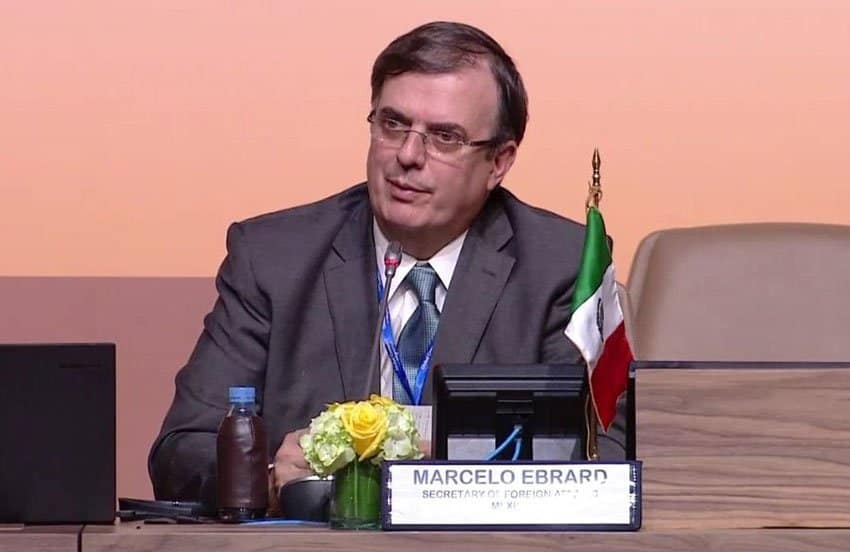
The federal government will invest more than US $30 billion over the next five years on a Comprehensive Development Plan with Guatemala, Honduras and El Salvador aimed at curbing migration to the United States, the foreign secretary said yesterday.
Speaking at a United Nations (UN) migration conference in Marrakech, Morocco, Marcelo Ebrard said that Mexico has made a commitment to cooperate closely with Central American countries and expressed confidence that the plan would be feasible and effective.
Ebrard said he expected that the plan, which will seek to develop Mexico’s poor southern states, would curb migration better than “containment measures.”
However, he didn’t explain exactly how the US $30 billion investment will be used or where the money would come from.
Thousands of Central American migrants have traveled through Mexico as part of several caravans during the past two months, leaving the authorities of the past and current federal government to grapple with finding a way to stem migration under increasing pressure to do so from the United States government.
Accompanied by his counterparts from the three “northern triangle” Central American countries, Ebrard said that “what happens to a migrant today in our country is a disgrace” and stressed that the new government would change Mexico’s approach to dealing with them.
“Mexico is going to change its migration policy, Mexico is going to make you feel proud about the pact we’ve adopted for safe, orderly and regular migration. We’re going to change things and it will be our actions that speak for us,” he said.

The foreign secretary said the aim of the development plan was to reduce poverty and thus address one of the key factors behind migration.
But Ebrard didn’t offer specific details about how money spent in southern Mexico would contribute to development in Central America. Mexican authorities said that specific details would be available in the coming weeks.
President López Obrador has said that Central Americans will be offered Mexican work visas and has also vowed to respect the human rights of migrants.
But he has also pushed for the United States to contribute to a plan to develop Central America that would reduce the root causes of migration.
In a letter to United States President Donald Trump shortly after his victory in the July 1 election, López Obrador proposed that Mexico, the U.S. and each Central American country contribute resources according to the size of its economy and that 75% of the collective funds be allocated to finance projects that create jobs and combat poverty, while the other 25% would go to border control and security.
“At the same time, every government, from Panama to the Rio Grande, would work to make the migration of its citizens economically unnecessary and take care of their borders to avoid the illegal transit of merchandise, weapons and drug trafficking which, we believe, would be the most humane and effective way to guarantee peace, tranquility, and security for our peoples and nations,” he wrote.
On the day of his inauguration, the new president agreed with his Honduran and Guatemalan counterparts as well as the vice-president of El Salvador to create a fund to stem the flow of migrants bound for the United States.
That country’s use of tear gas against a group of around 500 migrants who rushed the Mexico-United States border last month prompted a formal request from the former Mexican government for U.S. authorities to conduct a full investigation into the use of what it described as non-lethal weapons.
Trump threatened to close the United States southern border permanently in response to the attempted encroachment and is also reportedly pushing for a plan for migrants to stay in Mexico while their asylum requests are processed.
Ebrard met United States Secretary of State Mike Pompeo and Homeland Security Secretary Kirstjen Nielsen in Washington earlier this month but no agreement on the so-called “Remain in Mexico” plan has been announced.
Meanwhile, an increasing number of the thousands of migrants stranded in Tijuana are crossing or attempting to cross the border fence illegally to hand themselves into United States border patrol agents in order to circumvent a lengthy wait to apply for asylum from Mexico.
Source: El Financiero (sp), Reuters (en), The Los Angeles Times (en)