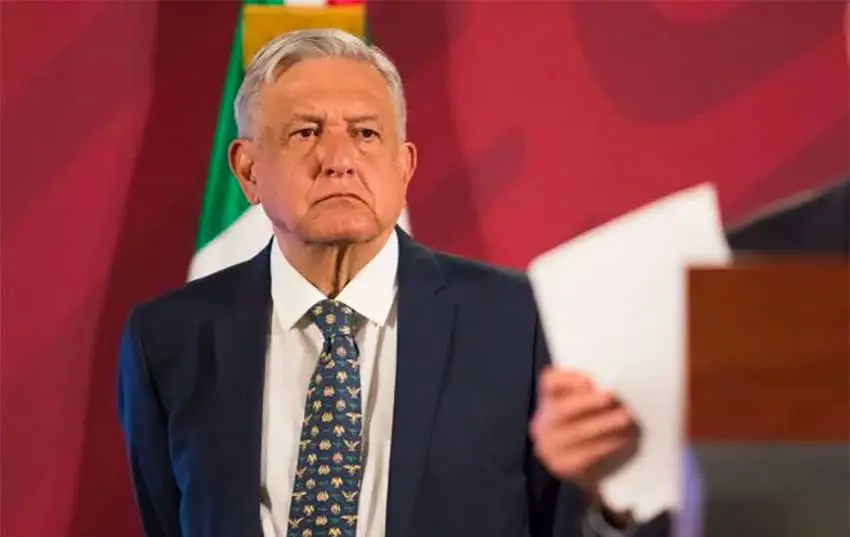
Diplomats from eight countries and the European Union met in Mexico City on Friday to discuss concerns about the federal government’s energy policy and how best to communicate them to President López Obrador.
The news agency Reuters reported that the United States Embassy hosted the talks and that diplomats from Canada, the United Kingdom, France, Germany, Italy, Spain, the Netherlands and the EU attended.
The broad diplomatic participation at the meeting is testament to the widespread concern about López Obrador’s break with the energy policy of the previous federal government, Reuters said. The economies represented at the meeting have traditionally been some of the biggest investors in Mexico.
Reuters reported that officials from the United States, Canada and the European nations say privately that the current government’s policy, which favors a greater role for the state in the energy sector, is undermining the legal foundations of contracts worth billions of dollars that were signed with the administration of former president Enrique Peña Nieto, who opened up Mexico’s oil and gas sector to foreign and private companies for the first time in almost 80 years.
López Obrador’s aim, they fear, is a gradual squeeze-out of the investments of foreign and private companies.

For its part, the Mexican government denies that it is sabotaging existing contracts, although it has said that some are unfair and harmful to the country. It has sought to renegotiate some of the contracts, such as those signed with three companies that built gas pipelines for the Federal Electricity Commission (CFE).
The government has also stopped Pemex from entering into new joint ventures with private companies, although it is seeking to muscle in on a large shallow-water oil project in the Gulf of Mexico, claiming that the reserve discovered by a consortium led by U.S. company Talos Energy extends into a block owned by the state oil company.

In addition, the government has attempted to strengthen the CFE by granting clean energy credits designed to encourage the development of new wind and solar farms to old, state-run renewable energy projects. Six foreign and Mexican renewable energy companies launched legal action against the rule change, arguing that it would severely harm clean energy investment, and a federal court upheld one injunction request.
Five people familiar with the talks at the U.S. Embassy on Friday told Reuters that the diplomats contemplated ways in which they could relay their energy policy concerns to López Obrador, who has pledged to “rescue” Mexico’s energy sector and has not held any new auctions to sell off oil and gas blocks since he took office in December 2018.
The diplomats say that the governments they represent have different opinions about how to communicate their complaints to the president, Reuters reported. However, there is a common aim: don’t give López Obrador the impression that he is being pushed about lest he decides to adopt an even more hardline approach with regard to state involvement in the energy sector.
Asked to comment on the discussions, the United States Embassy told Reuters that it doesn’t disclose its private diplomatic conversations, while the embassies of the other countries and the office of López Obrador didn’t respond to Reuters’ requests. However, one person told Reuters that there was a debate about whether to make the discussions public.
Some business groups have also criticized the government more broadly for scaring away foreign investment.
Claudia Jañez, president of the Executive Council of Global Companies, said in January that the business community is “deeply concerned” about increasing uncertainty and government “hostility” toward private investment. She charged that government interference in investment is the main cause of stagnation in the Mexican economy, which contracted by 0.1% last year.
At the same press conference, Business Coordinating Council (CCE) president Carlos Salazar Lomelín said that the government shouldn’t change rules because doing so creates economic uncertainty and hurts investment.
For his part, López Obrador has stressed that his government welcomes investment, and indeed direct foreign investment increased 4.2% in 2019 to US $32.92 billion pesos, according to preliminary statistics from the Economy Ministry.
However, Jañez said that investment last year, and that which will flow into Mexico in 2020, are the result of plans made between five and 10 years ago rather than an endorsement of the economic policy of the current federal government.
Source: Reuters (en)