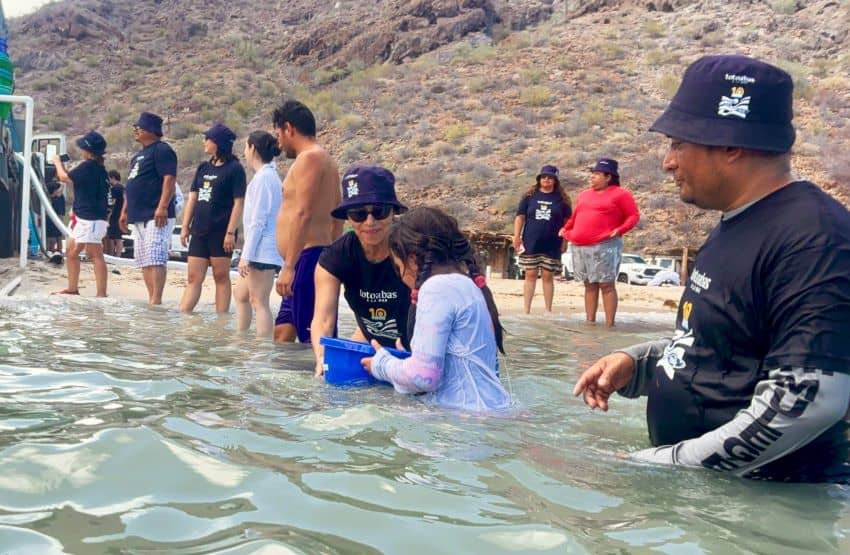
As part of a milestone conservation effort led by Mexico’s Environment Ministry, 40,000 baby totoaba fish were released into the waters of the Gulf of California, a unique ecosystem where this threatened species is endemic.
This marks the tenth generation of totoaba — 270,000 individuals in the past 10 years — that Mexico has reintroduced to prevent the extinction of the species. The fish plays a crucial role in marine balance in the Gulf, dubbed by Jacques Cousteau as “The Aquarium of the World.”
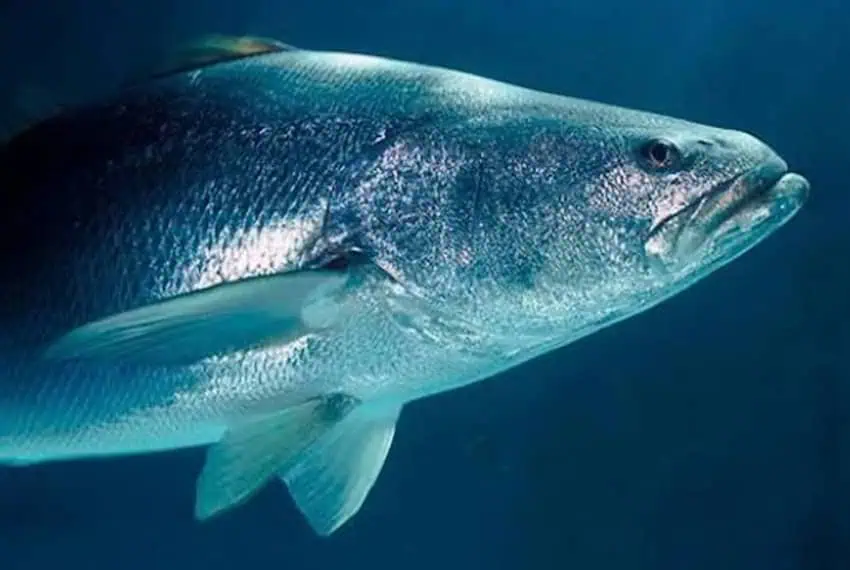
In an official statement, the Environment Ministry (Semarnat) said the release of the totoaba hatchlings — each about 25 centimeters long — “is the result of a collaborative effort between the private sector, civil society and the government.”
Thanks to the joint program involving Semarnat, the regenerative aquaculture company Santomar and civil society, the baby totoaba are now swimming freely in the waters off Santispac Beach, in the municipality of Mulegé, Baja California Sur.
The program aims to reverse decades of overfishing and illegal trafficking that have pushed the totoaba to the brink of extinction.
“The reintroduction effort promotes the recovery of this threatened species,” said Dr. Marina Robles García, undersecretary of Biodiversity and Environmental Restoration at Semarnat. “And this is possible thanks to totoaba cultivation in laboratories located in Sonora, Baja California and Baja California Sur.”
Robles García attributed the program’s success to scientific developments at the Institute of Oceanological Research at the Autonomous University of Baja California (UABC).

According to the website Big Fish, these research centers “have perfected the reproduction and rearing of the species under human care, then reintroduced them in a controlled manner to the wild.”
View this post on Instagram
Robles García said the program is also assisted by a new, state-of-the-art regenerative aquaculture system in La Paz, Baja California Sur. There, larval food is cultivated in tanks filled with microalgae.
“This joint effort shows that it is indeed possible to recover threatened species, as has already happened with the California condor and the Mexican wolf,” she said.
The totoaba repopulation scheme is also aided by the nine Wildlife Conservation Management Units (UMAS) that are dedicated to the care of the Gulf corvina fish, where around 3 million totoabas have been produced in recent years.
Though prohibited since 1975, illegal fishing of the totoaba continues due to the demand for the fish’s swim bladder, an organ that helps the fish control its buoyancy and is considered a delicacy in certain parts of Asia. The swim bladder can fetch prices of around US $500 per kilo in Mexico and $8,000 per kilo on the international market.
With the totoaba population stabilizing, the Mexican government last month amended the import/export tax law to grant Santomar, which cultivates the totoaba in submersible farms on the high seas, the exclusive authority to export totoaba meat as long as it adheres to traceability regulations. According to the newspaper Milenio, this modification seeks to exercise greater control over the illegal totoaba market.
Selling the swim bladder is still prohibited, as are sales of live totoaba.
With reports from Aristegui Noticias, Milenio and Big Fish