Residents of Jesús María, the town in Sinaloa where cartel leader Ovidio Guzmán was captured last week, protested outside Sinaloa’s Government Palace on Monday, saying that around 140 people have disappeared from their community since Guzmán’s arrest.
An estimated 200 demonstrators arrived at the Government Palace in the state capital of Culiacán in trucks Monday morning, waving placards and shouting slogans. They accused the Mexican army of human rights violations and demanded that the state government address the impact of military presence in their town.
“The children are afraid of seeing soldiers; we don’t want soldiers in the town,” one placard read.
“The government should tell the truth about what the town of Jesús María lived through,” read another.
Protesters broke some of the glass in the doors of the Government Palace, causing the state police to block their access to the building. Sinaloa governor Rubén Rocha Moya agreed to meet with community representatives a few hours later and reportedly promised that he would ask President López Obrador to withdraw military forces from the area.
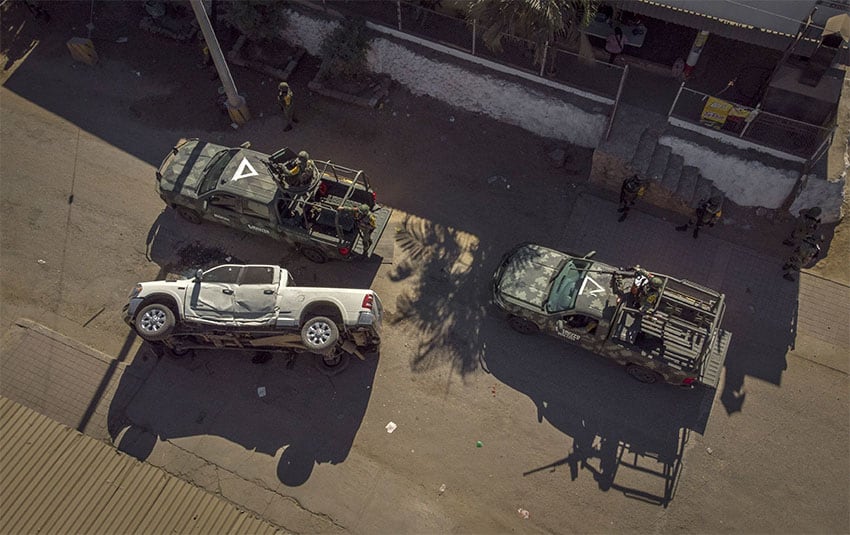
Jesús María was the epicenter of the operation to capture Guzmán on the morning of Jan. 5, which included a fierce exchange of fire between Mexican military aircraft and gunmen on the ground. Following the operation, Guzmán’s followers terrorized the municipality with armed attacks and blockaded highways around the state for around 12 hours, leaving at least 29 soldiers and cartel members dead.

The army blocked access to Jesús María as searches were conducted, and shut off the town’s electricity, telecommunications and water supply. Although a humanitarian mission was dispatched on Sunday to attend to the community’s needs, residents expressed anger that their town remained occupied by soldiers several days after Guzmán’s capture.
In contrast to the government’s claims that the operation caused no civilian casualties, local people estimate that around 140 people are missing — mostly young men and women between 12 and 35 years of age — and an unspecified number of injuries.
Sinaloa’s Public Security Secretary, Cristóbal Castañeda, confirmed that the state government had received reports of missing people during the humanitarian visit to Jesús María on Sunday, but said the exact number was unknown.
“We don’t really have a number of people not located,” he said. “They are waiting for the complaints to be established; we need to know whom to look for… we know that the Semefo [Forensic Medical Service] has been handing over the bodies of those identified.”
With reports from Animal Político, El País and Noroeste