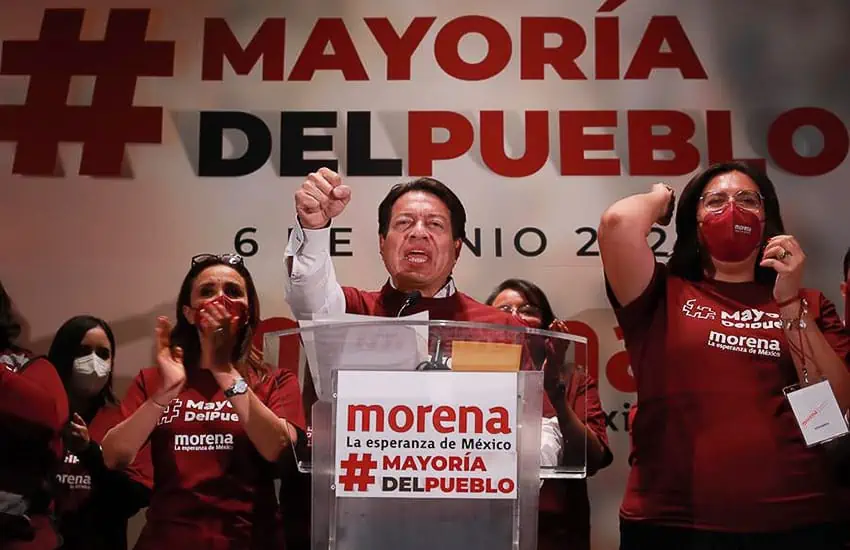
The Morena party will likely hold the majority of seats in at least 20 state legislatures as a result of last Sunday’s elections, a situation that could help the government enact constitutional reforms as such changes require ratification by a majority of Mexico’s 32 states.
The party founded by President López Obrador is set to have a very strong majority in the legislatures of Baja California, Chiapas, Nayarit, Sinaloa and Tabasco as preliminary results show that Morena won all of the directly elected seats. It will pick up additional seats in those states once the proportional representation seats are allocated.
With the support of the Labor Party, the Green Party and small local parties in some entities, Morena will also have a clear majority in Baja California Sur, Colima, Guerrero, Hidalgo, Oaxaca, Puebla, Mexico City, Sonora, Tamaulipas, Tlaxcala and Veracruz. It already has a clear majority in Quintana Roo, where state elections were not held Sunday.
Preliminary results show that Morena will also obtain a narrow majority in the legislatures of Campeche, Morelos and Zacatecas.
The conservative National Action Party will have a strong majority on its own in Aguascalientes, Durango, Guanajuato, Querétaro and Yucatán, while its coalition with the Institutional Revolutionary Party (PRI) and the Democratic Revolution Party will dominate the legislatures of Chihuahua, Michoacán and Nuevo León. The PRI controls the Congress in Coahuila, where citizens voted for municipal and federal representatives on Sunday but not state ones.
Preliminary results indicate that no single party or coalition will have a majority in the legislatures of México state and San Luis Potosí, while the Citizens Movement party is on track to be the dominant force in the Jalisco Congress.
Morena, which lost the two-thirds supermajority it currently shares with its allies in the lower house of the federal Congress, will also hold the governorships of about half of Mexico’s states after winning at least 10 gubernatorial races on Sunday. The newspaper Reforma reported that it appears likely that 21 states will have legislatures controlled by the same party or coalition that holds the governorship. That will make it much easier for the governors of those states to enact their legislative agendas.

Morena’s loss of its supermajority in the federal Chamber of Deputies appears likely to stifle López Obrador’s ambition to overhaul the energy sector in favor of state-owned companies and enact transformative changes that require constitutional reform and thus the support of two-thirds of lawmakers. Once the new deputies take their seats in the lower house in September, Morena won’t have a supermajority in either the Chamber of Deputies or the Senate.
However, if Morena does manage to get constitutional reforms through Congress with the support of opposition lawmakers, it should have few difficulties getting them ratified by a majority of the states.
López Obrador said earlier this week that Morena could gain support at the federal level for its agenda from some PRI lawmakers or those of other opposition parties, even though he is highly critical of them. The PRI national president Alejandro Moreno indicated a willingness to discuss the proposition, but whether a Morena-PRI pact will unfold remains unclear.
With reports from Reforma (sp)