
The ruling Morena party will lose its exclusive majority in the Chamber of Deputies at the June 6 elections but the coalition it leads will retain control of the lower house of Congress, a new poll indicates.
Morena currently holds 256 of the 500 seats in the lower house but will win only 230 at the upcoming elections, according to the poll conducted by SIMO Consulting for the newspaper El País.
The consulting firm — which last week surveyed 2,000 Mexican adults about their voting intentions and subsequently used a complex mathematical model to estimate the future makeup of the Chamber of Deputies — found that 44% of poll respondents plan to vote for Morena.
The poll found that 5% of respondents intend to vote for the Ecological Green Party of Mexico (PVEM), a Morena ally that was formerly partnered with the Institutional Revolutionary Party (PRI). SIMO estimates that the party will win 53 seats in the lower house, 42 more than it currently holds.
Three hundred of the 500 deputies are elected directly. The occupants of the other 200 seats are determined by proportional representation.
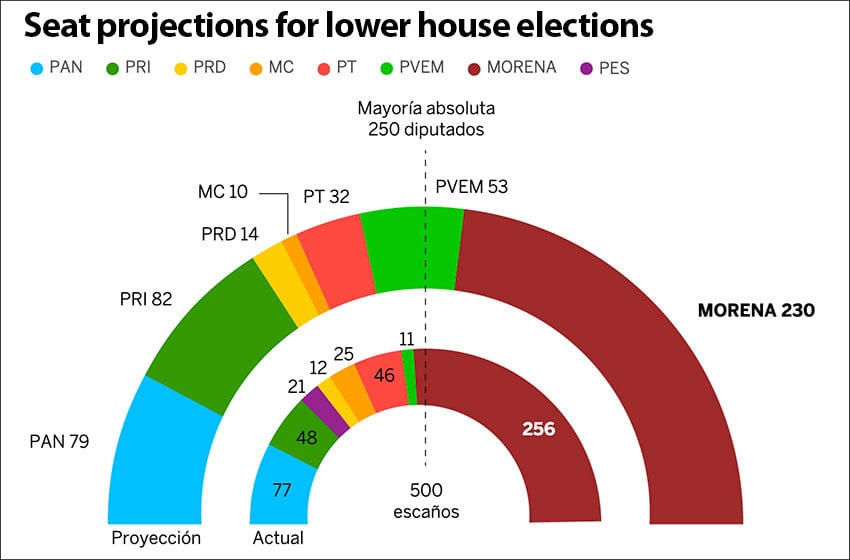
The poll found that 3% of respondents intend to vote for the Labor Party (PT) — another Morena ally. SIMO predicts the party will win 32 seats, a decrease of 14 compared.
If the consulting firm’s predictions come true, the Morena-PVEM-PT alliance will win 315 seats, which would be a strong majority in the lower house but not the two-thirds majority needed to approve constitutional changes.

The figure is 19 fewer than the 334 seats the Morena-led alliance — which also includes the Social Encounter Party (PES) — currently holds. The PES, now known as the Solidary Encounter Party, is predicted to lose all of its 21 seats at the upcoming elections.
SIMO’s poll found that 45% of respondents intend to vote for opposition parties, which are on track to collectively win 185 seats.
The PRI, which suffered a humiliating defeat at the 2018 elections largely as a result of the scandal-plagued presidency of Enrique Peña Nieto, will win 19% of the vote and 82 seats in the lower house, according to SIMO, a result that would allow it to supplant the National Action Party (PAN) as the main opposition.
The PRI, which entered into a coalition with the PAN and the Democratic Revolution Party (PRD) to contest the elections, currently holds just 48 seats.
The conservative PAN will win 18% of the vote and 79 seats, according to SIMO, two more than it currently has.
The leftist PRD — López Obrador’s former party that is now highly critical of the president — will win 3% of the vote and 14 seats, a result would also increase the number of seats the PRD holds by two.
The Citizens Movement (MC) party, a leading contender to win the prized governorship of Nuevo León, will attract 5% of the vote in the lower house but only win 10 seats, a result that would leave the party with 15 fewer seats than it currently holds.
The results of the poll commissioned by El País are similar to those of a poll of polls collated by the website Oraculus.
Oraculus also predicts that the ruling party will lose the majority it currently enjoys on its own but anticipates that the Morena-PVEM-PT alliance will win a combined 308 seats.
Another poll indicates that not only will Morena lose its exclusive majority in the Chamber of Deputies but also surrender its control of the house through its alliance.
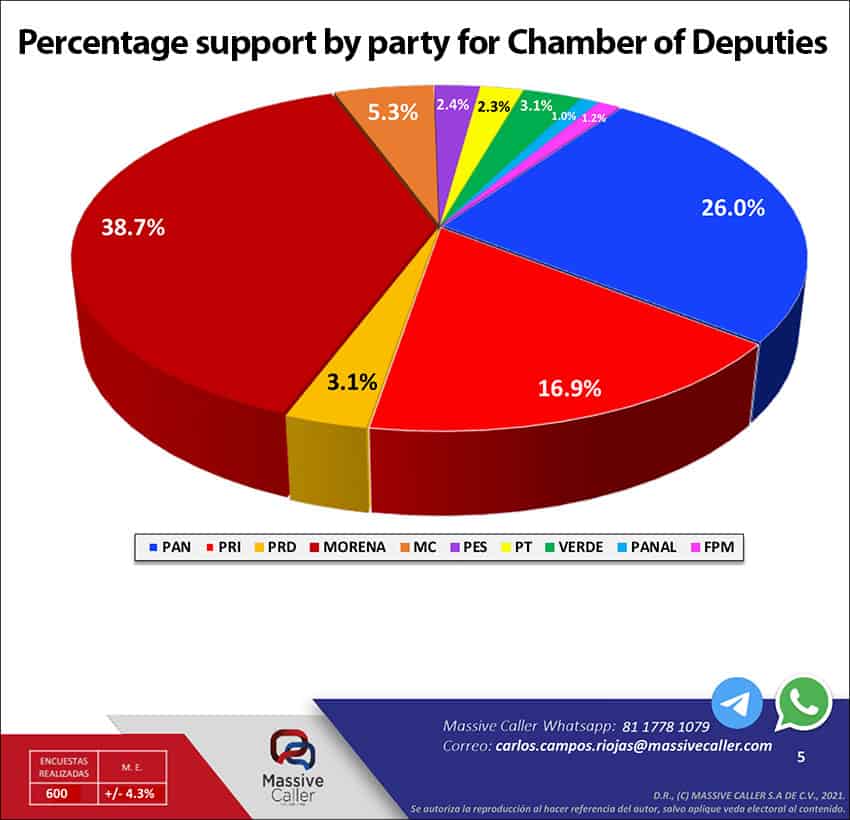
Based on the results of an automated telephone poll conducted last Thursday with 600 people, the polling company Massive Caller predicts that Morena will win just 195 of the 500 seats. The Morena-PVEM-PT alliance will win 242, Massive Caller predicts, meaning that opposition parties — as a result of winning the other 258 seats — would together control the lower house of Congress and have the capacity to scuttle López Obrador’s legislative agenda.
As the Chamber of Deputies is responsible for approving Mexico’s federal budget, the anti-government forces could also force the government to reformulate its spending plans in the second half of its six-year term.
Massive Caller predicts that the PAN will win 150 seats, which would give it the second-highest number of deputies after Morena. It predicts that 71 seats will go to the PRI, the PRD will win 20 and the MC will take 17.
Although the SIMO/El País poll determined that Morena is on track to lose its own majority, it found that AMLO retains a high approval rating 2 1/2 years into his term. Two-thirds of respondents indicated that they approve of the president’s performance, with 30% saying they very much approve and 36% saying they somewhat approve.
Just under a third of respondents — 29% — said they very much or somewhat disapprove of López Obrador’s performance while the remaining 5% either said they didn’t know or didn’t respond.
The president has maintained a high, albeit declining, approval rating in most polls despite widespread criticism of his government’s management of the coronavirus pandemic, an 8.5% economic slump in 2020 and ongoing high levels of violence.
Many polls have previously suggested that his popularity will translate into a strong showing for Morena at the June 6 elections but the most recent surveys clearly show that the race is tightening.
The SIMO and Oraculus polls indicate that the ruling party will have to depend on its allies to pass legislation, while to approve constitutional reforms – which López Obrador has indicated he is prepared to pursue in order to carry out his “fourth transformation” of Mexico – Morena would have to gain the support of at least some opposition lawmakers, which in Mexico’s polarized political landscape would be an extremely difficult, if not outright impossible, task.