An operation by the Colima State Attorney General’s Office (FGEC) on Monday left two suspected criminals dead and two police officers wounded, one seriously.
State officials said that a U.S. citizen wanted for homicide in the United States was detained by Mexican agents as part of the operation. The authorities also seized a homemade armored vehicle, as well as several rifles, handguns, grenades and drugs.
REPORTAN NARCOBLOQUEOS EN TECOMÁN; CHOCA TREN CONTRA TRÁILER INCENDIADO
Al menos dos narcobloqueos se registraron la tarde de este lunes en el municipio de Tecomán, Colima.
En la autopista Manzanillo-Colima, a la altura de la colonia Bayardo y la gasolinera El Llano, se… pic.twitter.com/579WRYrzpH
— Oscar Adrián (@OscarAdrianL) May 26, 2026
The FGEC deployment was said to be in response to a 911 call, while the digital publication Aristegui Noticias reported that the agents were targeting a suspected safe house linked to the Jalisco New Generation Cartel (CJNG). Colima borders the state of Jalisco.

According to local media outlets, the initial confrontation occurred in the community of Caleras when armed men in a vehicle fired upon the FGEC agents, who repelled the attack. In the initial confrontation, the two law enforcement officers were injured and one of the suspects was killed.
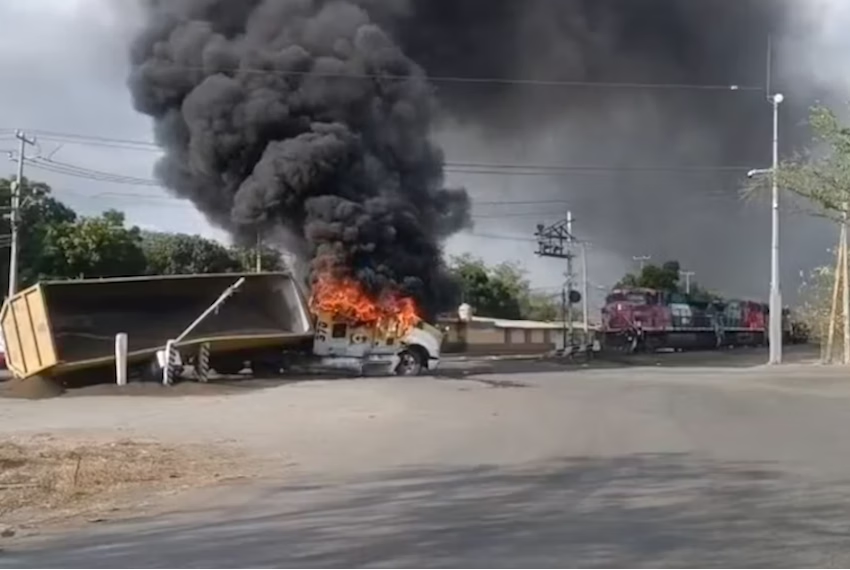
To avoid capture, the criminals established a roadblock by setting vehicles and cargo trucks on fire, obstructing the Colima-Manzanillo highway. Subsequently, the violence spread to other areas of the state.
The shootout triggered national security alarms, prompting the Navy Ministry, the Defense Ministry, the National Guard and State Police to mobilize in support of the FGEC officers.
Members of these federal agencies engaged in clashes with suspected criminals across the state.
Shortly after the original confrontation, the suspects blocked traffic at access points to the city of Tecomán, setting tractor-trailers on fire, with several incidents captured in videos that circulated on social media Monday afternoon.
One of the videos shows a freight train slowly colliding with a tractor-trailer that had been placed across the tracks. The train did not derail and no injuries were reported.
As a result of the violence, Colima Governor Indira Vizcaíno ordered schools in four of the state’s 10 municipalities to conduct remote classes on Tuesday, since security operations are ongoing.
In a press release issued late Monday night, state authorities said FGEC agents were carrying out investigative tasks in the municipality of Tecomán when they were fired upon by armed men in a vehicle.
The authorities added that most of the blockades were cleared and the vehicle fires — including along the Guadalajara-Colima and Manzanillo-Colima highways — were extinguished. Although the highways were cleared for traffic shortly after midnight, some roadblocks remained in Tecomán and Armería.
With reports from Aristegui Noticias, El País, InformadorMX and Infobae