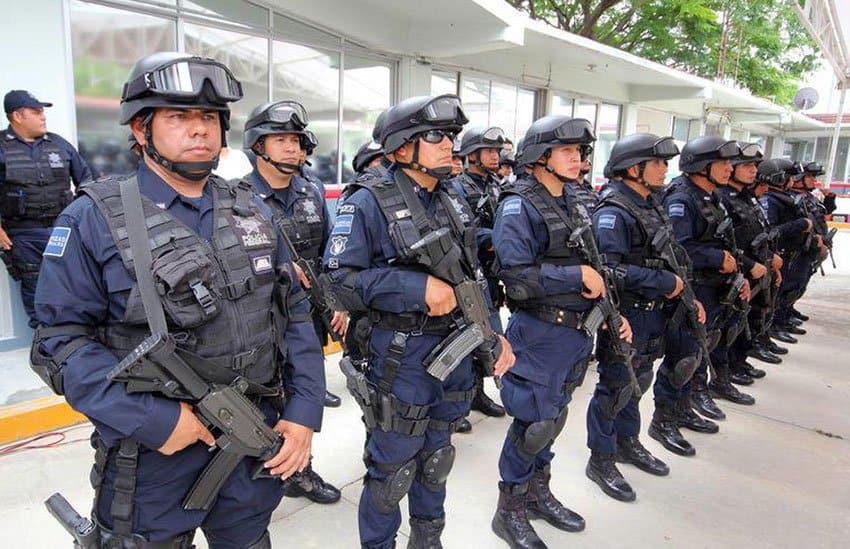
Mexico’s new national guard, the centerpiece of the incoming government’s national security plan, will initially be made up of 83,000 officers, according to the proposed constitutional reform that would create it.
The Federal Police will contribute 37,000 officers to the new security force, while 36,000 soldiers and 10,000 marines will also join its ranks. It will be under the control of the army.
The Morena party’s leader in the Chamber of Deputies, Mario Delgado, said the new government intends to add 50,000 more members to the national guard over the next three years.
He stressed that the Federal Police would not disappear – immediately, at least, explaining that its duties would be transferred gradually to the new force.
All officers admitted to the guard will be required to pass examinations, Delgado said, meaning that there will be no free passes into the force.
“The Federal Police won’t disappear [just] because there is movement of some officers to the national guard. It’s going to continue. According to this initiative, those who make up the national guard will have to comply with certain requirements . . . The officers who pass [the exams] will gradually go into the national guard,” the lawmaker explained.
At some point in the future, the new security force will also recruit ordinary citizens to bolster its ranks, according to details in the proposed constitutional reform presented in Congress yesterday.

Before joining the national guard, civilians would undertake physical and academic training at military bases following a curriculum that will be developed jointly by the secretariats of Defense, the Navy, the Interior and Public Security.
The federal Attorney General’s office (PGR) and the National Human Rights Commission (CNDH) will also be invited to offer input.
The fifth provision of the proposed constitutional reform states that the guard will remain active while high levels of violence and insecurity continue to afflict the country.
However, the force will be subject to review three years after its creation.
Although members of the military will initially join it, the proposed reform says that the aim is for soldiers and marines to cease carrying out public security duties and return, in the short term, to their role as defenders of the nation.
Non-governmental organizations including Human Rights Watch and Amnesty International have rejected the plan to create a national guard, arguing that it perpetuates a failed militarized crime-fighting strategy.
But the text of the initiative presented yesterday differed vastly in its assessment.
“. . . A disciplined and specially-trained force will be formed and deployed . . . to safeguard people’s rights and property and to preserve order and public peace. Our proposal makes progress in the sense of demilitarizing the streets of Mexico,” it said.
Delgado also rejected the claims that the incoming government’s security plan represents a continuation of the militarized strategy implemented by former president Felipe Calderón in 2006 and continued by the current federal government.
However, like the new Tabasco oil refinery and the Maya train, the whole plan is still subject to one small detail — the will of the people.
President-elect López Obrador said today that he will put the question of creating the national guard to yet another public consultation.
In an interview with journalist Carmen Aristegui, López Obrador, who has previously advocated for demilitarization, said he had not fully realized how corrupt Mexico’s civilian security forces were.
He also defended the nation’s military, stating that the human rights violations it has committed were “on orders received from civilian authorities.”
Source: El Universal (sp), Associated Press (en)