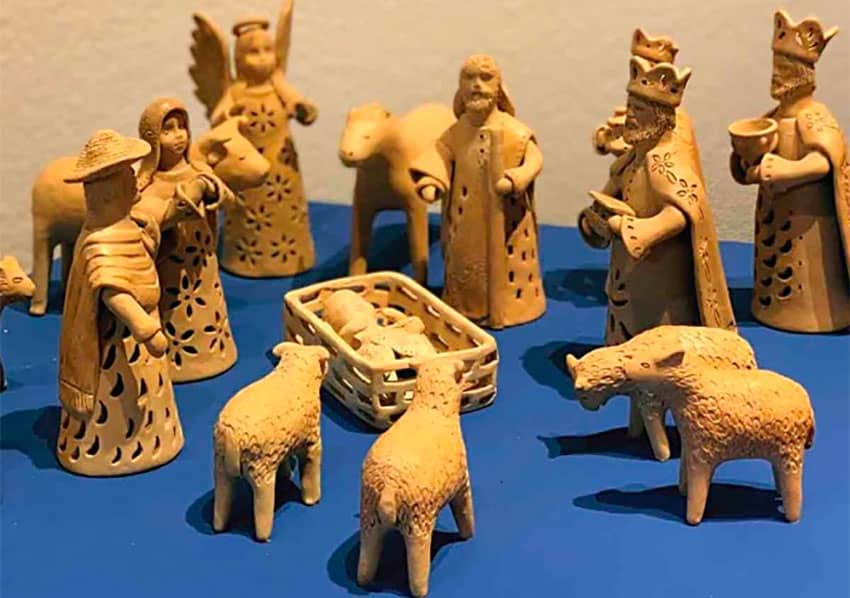
Although Christmas trees have become more and more popular, the nativity scene remains the center of the Christmas season. Placed in prominent locations in homes, these scenes play a role from before Christmas Day to Candlemas.
Usually, they are found on a table which may be set up for this purpose. However, it is not unusual to see scenes placed under Christmas trees, essentially incorporating this relatively new element as part of the scene.
About a week or so before Christmas, the scenes have something important missing — the baby Jesus himself. This is because before Christmas Eve, he has not yet been “born” so he is placed there sometime during the night.
While Christmas is an important family holiday, the observance does not stop there. The next important date related to the nativity is January 6, Epiphany, or Three Kings Day (day of the Reyes Magos). This is the date on which Mexican children traditionally receive gifts.
The last date related to the nativity is February 2, Candelmas, celebrating Jesus’s presentation to the temple. This idea here is to take an image of the baby Jesus to Mass. However, since most nativity scenes are the size of a dollhouse, the figures of Jesus associated with them are quite small. So life-size images of Jesus are dressed up and taken to church.
Since Mexico is still a very Catholic country, at least culturally, there aren’t the qualms about public nativities that exist in other countries. They are common in just about every city and town with some, like the city of Oaxaca, having notable ones in their main square. There have even been nativity scenes large enough to fill football stadiums.
Most scenes sold in markets and stores today are mass-produced. But Mexico has a long tradition of making them from just about any material imaginable, such as stone, clay, glass, corn husks and cloth. They may be simple or elaborate.

Exhibitions of and about nativity scenes are common in December and January as well. The Fomento Cultural Banamex currently has exhibitions from its vast folk art collection on display in Mexico City, at its main museum at the Palacio de Iturbide and the Foro Valparaíso, both in the historic center.
For 18 years, an individual family in León, Guanajuato, has had a tradition of exhibiting its own collection of 110 nativity scenes from 40 different countries including Israel, Norway, France and Spain. It is the only exhibition of its kind in Mexico and attracts over 50,000 visitors each year. The collection includes scenes so small that they are placed in eggshells and matchboxes.