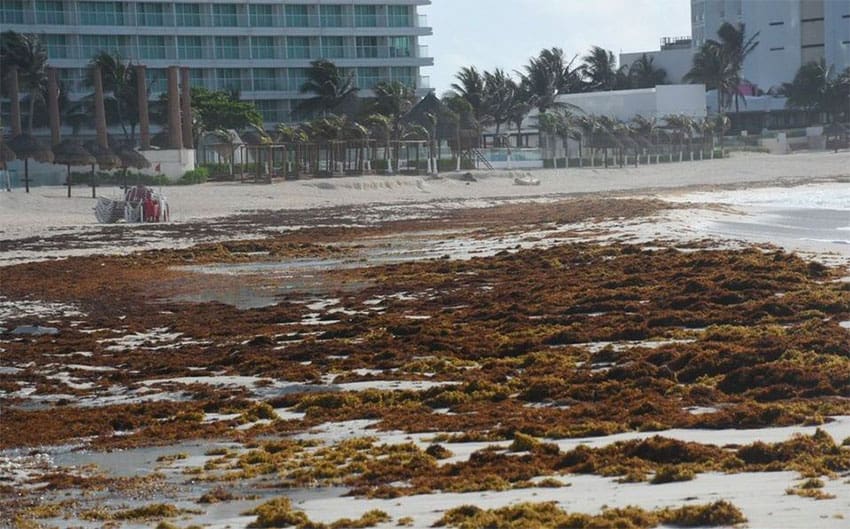
The navy has asked the Ministry of Finance (SHCP) to approve spending of 90.2 million pesos (US $4.2 million) to combat the arrival of sargassum on Caribbean coast beaches.
In a document seen by the newspaper Milenio, the Ministry of the Navy (Semar) proposes buying five sargassum-gathering vessels, materials for the construction of two more, containment barriers and beach sweepers.
Semar said the investment will allow Quintana Roo’s beaches to be kept clean and attract more tourists.
Quintana Roo hoteliers and other tourism sector representatives are hopeful that they will be able to start welcoming tourists back starting next week, and have launched a new promotional campaign to attract visitors.
However, Quintana Roo is still classified as a “red light” maximum risk state, according to the federal government’s stoplight system to determine which coronavirus restrictions can be lifted and where.
But the color allocated to each state is updated on a weekly basis, meaning that there is hope that Quintana Roo will start next week with a lower coronavirus risk level. There are currently 284 active cases in the Caribbean coast state, according to official data published on Monday.
The Covid-19 pandemic has devastated the state’s tourism industry, with losses estimated to be US $1 billion in Cancún alone.

Before the emergence of the infectious disease, the biggest threats to the tourism sector were insecurity and the annual arrival of sargassum, an unsightly and smelly seaweed.
The amount of sargassum was up 40% last year, according to Semar, affecting the coastline of mainland Quintana Roo as well as the islands of Cozumel and Isla Mujeres.
In its submission to the SHCP, Semar said that almost 85 million tonnes of sargassum were cleared from beaches last year and that 544 cubic meters of the weed were removed from the sea off the Quintana Roo coast.
It said that an alternative to purchasing its own sargassum-fighting equipment – the federal government gave the navy the responsibility to combat the problem at the start of last year’s seaweed season – would be to hire a private company that specializes in the removal of the macroalgae.
However, containment barriers and machinery to clean beaches, such as tractors and sweepers, would still have to be purchased, Semar said.
The total cost, including the hiring of a private company, would be just under 111.4 million pesos, the navy said, over 20 million pesos more than its own proposal.
This year’s sargassum invasion is expected to be smaller than those seen in the last two years. The first of this year’s seaweed arrived in early May but as of late last week very little had arrived in Quintana Roo so far.
Source: Milenio (sp)