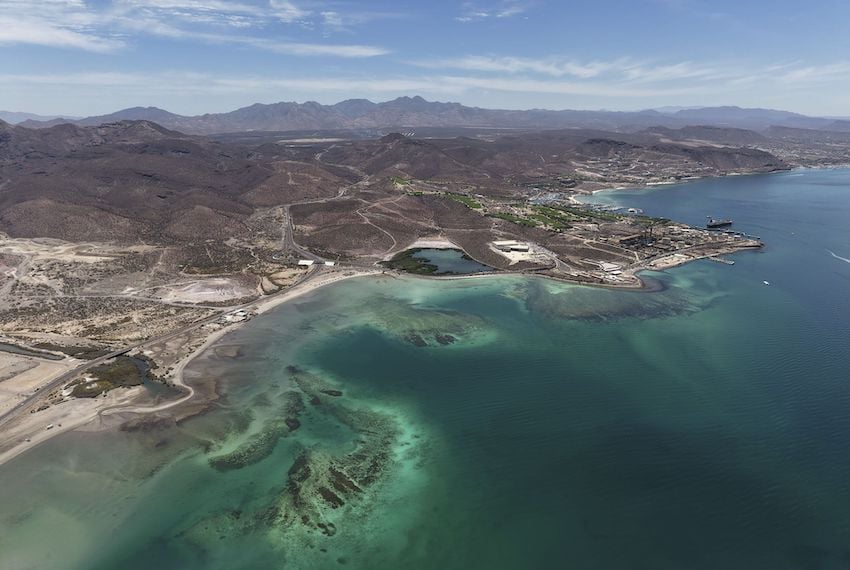
The map might lend the impression that the Gulf of California is Mexican territory, but that’s not the case.
A paper published by Mexico’s Center for Advanced Naval Studies (CESNAV) proposes rectifying the situation in order to exercise full sovereignty over “the world’s aquarium” in the name of national security.
In an essay titled “Geostrategic Importance of the Gulf of California: A Vision Towards the Historic Bay,” Naval Captain Carlos Alejandro Sans Aguilar suggests petitioning the International Maritime Organization to reclassify that area as a “historic bay,” a designation that would allow Mexico to treat it like land territory and enforce its own laws.
A “historic bay” is a body of water that a coastal nation claims as its internal waters, despite not meeting standard geographical criteria. The claim is based on the nation having traditionally and openly exercised continuous, long-term control with the implicit or explicit acquiescence of other nations.
The entire Gulf — an area of approximately 50,000 square nautical miles — is considered a marginal sea of the Pacific Ocean and Mexico’s national waters only extend 12 nautical miles from its coastlines on either side of the 700-mile-long body of water.
The upper part of the Gulf — el Alto Golfo de California — is the only section designated as internal waters, meaning Mexico formally has control of only the northern third of the Gulf.
According to the U.N. Convention on the Law of the Sea (UNCLOS), the central and southern thirds are international waters.

The rationale for the author’s request is to rid the Gulf of foreign powers as well as organized crime gangs that use the waters for illegal activities, such as piracy, poaching, human trafficking and drug trafficking.
The essay argues that the current condition “undermines Mexico’s sovereignty and national security due to the implicit freedom of navigation and overflight.” The legal status of the southern two-thirds of that part of the sea “allows various socioeconomic activities to be carried out, without the Mexican State being able to do anything about it.”
One recent incident cited by advocates for this change is a U.S. spy flight that took place on Feb. 2.
A U.S. Air Force plane entered the Gulf from the Pacific Ocean and flew north about 370 miles before turning around and flying south along the same track.
Pentagon’s 18 spy plane missions near US-Mexico border spark surveillance concerns
In March, Deputy Gustavo de Hoyos presented legislation to reform Mexico’s Federal Law of the Sea and to petition for the reclassification of the Gulf as “a historic bay or inland sea,” while saying “the lack of absolute control represents a strategic vulnerability for Mexico’s foreign policy.”
“Mexico meets the standards of international law to justify this reclassification, as it has exercised effective sovereignty over the region for centuries, without objection from the international community,” the bill states, “and consolidating sovereignty over the Gulf will strengthen national security, the protection of maritime resources, and geopolitical stability in the region.”
With reports from El Sol de México and Infobae