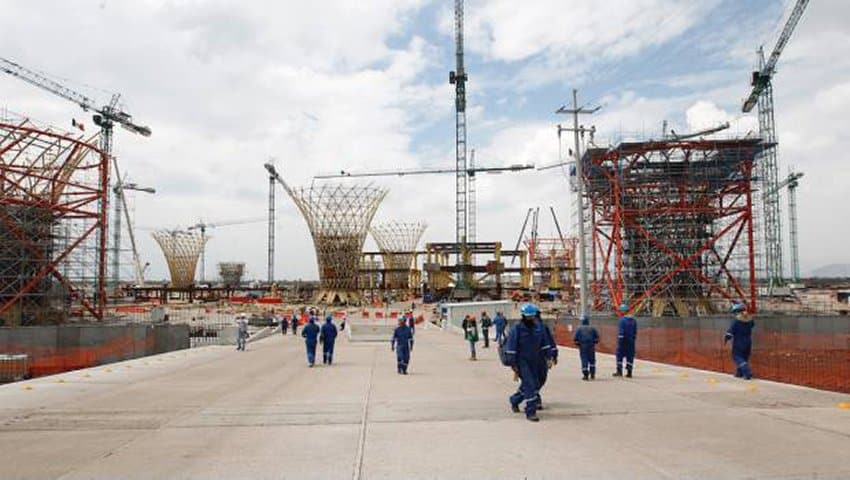
Construction of the new Mexico City International Airport is only one year behind schedule and not two, says the project’s infrastructure director.
Raúl González Apaolaza told broadcaster Televisa today that the airport will commence operations in 2021 instead of October 2020 as originally scheduled.
González’s view contrasts with information provided by Parsons Corporation, which has provided program management services for the project since 2014.
In a document seen by the news agency Bloomberg, the consultancy says that the airport won’t be ready until the second half of 2022.
One element of the project that is behind schedule is the x-shaped terminal building, which is expected to be finished in August 2021.
But regardless of the status of construction, whether the new airport ever opens remains in doubt as president-elect López Obrador and his transition team push ahead with plans to put the project up for a popular vote.
Jesús Ramírez, spokesman for the incoming government, yesterday revealed the question that citizens will be asked in the public consultation scheduled to take place between October 25 and 28.

“Given the saturation of the Mexico City International Airport, which option do you think is better for the country?
“A) Recondition the Mexico City and Toluca airports and build two runways at the Santa Lucía Air Force Base or;
“B) Continue with the construction of the new airport in Texcoco and cease using the current Mexico City International Airport.”
On the reverse side of the ballot, a summary of the pros and cons of both proposals will be printed.
Option B appears the most likely winner, according to a recent poll conducted by the newspaper El Financiero, which showed that 62% of respondents were in favor of the project continuing while just 27% wanted it to be canceled.
Ramírez said the cost of the consultation, to be held in 538 municipalities across the country, will be about 1.5 million pesos (US $80,000) and that the money would come from voluntary contributions from members of Congress.
Infrastructure director González urged that documents indicating the operational safety of both the new airport project and the Santa Lucía option be made available to the public before the consultation takes place.
The suitability of the Texcoco site has been questioned due to its location on an ancient lake bed while some aviation experts have said that the existing airport is too close to the México state air force base for both to operate commercial flights.
But civil aviation consultant Víctor Hernández believes that the two facilities can operate simultaneously.
“. . . Santa Lucía is compatible . . . There is a study that determined that it could be used for commercial purposes, it is feasible,” he said.
However, option A would come at a considerable cost.
Future transportation secretary Javier Jiménez Espriú said in August that canceling the new airport and adapting the Santa Lucía base for commercial aviation instead would cost 170 billion pesos (US $9 billion).
Source: El Financiero (sp), Milenio (sp)