Teacher evaluations officially end today after the federal government’s new education reform was declared constitutional by Congress yesterday.
The Secretariat of Education (SEP) said that all other provisions in the previous government’s general teaching service law are also suspended effective today.
Public Education Secretary Esteban Moctezuma Barragán told a press conference that the “punitive education reform” implemented by the Enrique Peña Nieto-led administration has been repealed and that “teachers are now considered agents of change.”
With the adoption of the new National Education Agreement teachers’ rights are fully protected and there will never again be a campaign to discredit them, he said.
Moctezuma asserted that laws that were harmful to the teaching profession have been eliminated and declared that yesterday – Teachers’ Day – was a day to be celebrated.
Compulsory evaluations introduced by the former government as part of its 2013 education reform were condemned by the CNTE teachers’ union, which held countless protests to demonstrate its opposition.
The evaluations were used to determine whether a teacher was sufficiently prepared to be in the classroom. Many of those who failed to make the grade were dismissed.

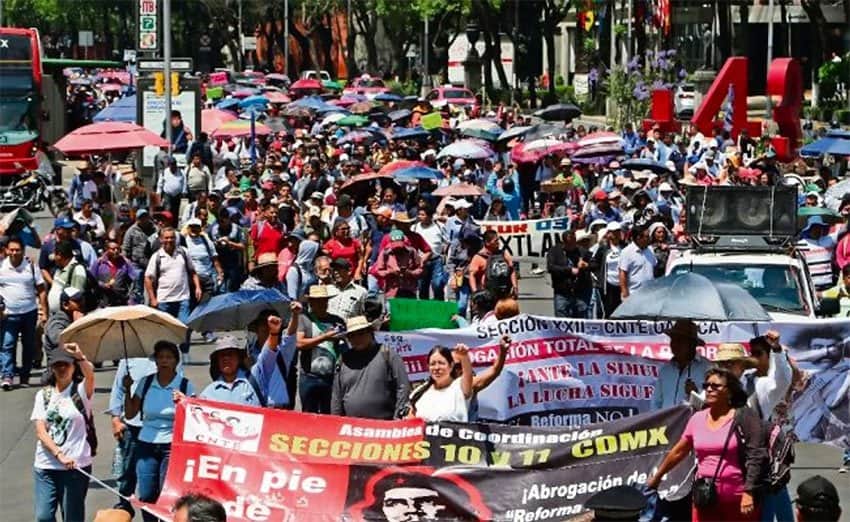
Yesterday, members of the union took to the streets of Mexico City but not to celebrate the end of the previous government’s reform. Instead they protested against the new one, arguing that the government hasn’t done enough to address their concerns.
Among their demands are the reinstatement of hundreds of dismissed colleagues and compensation for alleged wrongdoings committed by the previous government, such as the unjustified docking of their pay.
The teachers from Oaxaca, Chiapas, Guerrero, Michoacán and Mexico City also demanded that the government improve their working conditions and guarantee high-quality public education.
Some union members asserted that the government’s repeal of the 2013 reform is a simulation.
“The new reform . . . follows on from the Institutional Revolutionary Party [PRI] reform. When he was campaigning, [President] López Obrador said with clear words that . . . he would abrogate Peña Nieto’s reform but that’s not the case,” said Lázaro Martínez, a member of Section 14 in Guerrero.
“It doesn’t defend labor rights of all education workers . . . today the privatization of education continues.”
The CNTE said that teachers reject the “legislative process of the education reform” and will strike for 72 hours “in the absence of agreements with the federal government.”
Speaking at his morning press conference today, the president said he will meet Monday with leaders of both the CNTE and SNTE teachers’ unions.
“We’re going to meet and listen to them on Monday. We’re willing to listen and everything that represents an improvement for education must be taken into account; if something’s missing in the reform, it will be revised, we’re not inflexible,” López Obrador said.
Source: El Financiero (sp), Animal Político (sp), El Economista (sp)