For the second time in less than two years, scientists are considering the possibility that increased seismic activity in Michoacán could be the precursor to the birth of a new volcano.
There were 236 low magnitude micro-earthquakes and six tremors of a magnitude above 4 in the area surrounding Uruapan between May 1 and June 8. There were also more than 300 micro-quakes in the same area in the first four months of the year.
Carlos Valdés González, a researcher at the Institute of Geophysics at the National Autonomous University (UNAM) and a former National Disaster Prevention Center chief, said it’s essential to monitor such earthquake swarms — the name for sequences of similar magnitude seismic events occurring in a local area in a relatively short period of time — because they could indeed foretell the creation of a new volcano.
He told the newspaper Milenio that for a volcanic eruption to occur and for a new volcano to form, there must be seismic activity.
“… Mexico is a volcanically active country, especially in that region [near Uruapan], where there are more than 1,200 small volcanoes in the so-called Michoacán-Guanajuato volcanic field,” Valdés said.
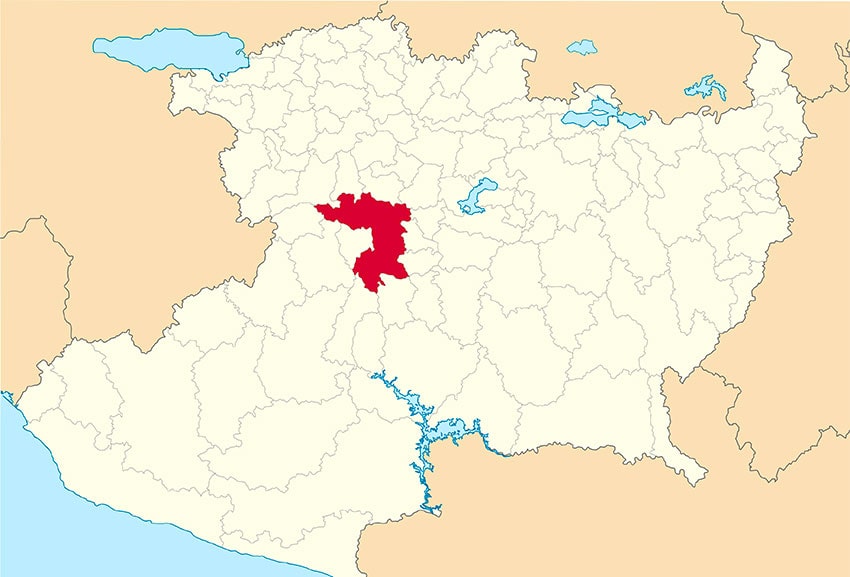
The researcher recalled that the Paricutín volcano, located about 50 kilometers northwest of Uruapan, suddenly emerged in 1943 following a series of earthquakes.
A team of experts carried out studies early last year after more than 3,000 low magnitude earthquakes were recorded in January and February, but it was ultimately determined that the increased seismic activity would not lead to the birth of a new volcano. Scientists concluded that most of the magma movements detected were horizontal rather than vertical and for that reason, the molten material would not ascend to the surface.

The question that researchers are entertaining is if the earthquake swarms being observed more recently mean that anything has changed.
Valdés and two other UNAM researchers have said that there is no current conclusive evidence that a new volcano will appear, but all emphasized the need for ongoing scientific monitoring and advised people in the area to follow all recommendations issued by Civil Protection authorities in order to ensure their safety.
Denis Xavier Francois Legrand, another UNAM researcher, told Milenio that while an earthquake swarm is an important pre-condition for the formation of a new volcano, it is not the only one. Among the others are a deformation in the Earth’s crust that allows a volcano to pierce through from below and the upward, rather than sideways, movement of magma. When Institute of Geophysics researchers investigated the earthquake swarm last year, they noted that such deformations were minimal.
“We assume that these [earthquake] swarms are associated with the movement of magma, but it doesn’t always reach the surface. These swarms [also] occurred in 1997, 1999 and 2006, but magma didn’t reach the surface [of the Earth]. Perhaps the same thing is happening now, but it’s very important to keep monitoring [the magma movements],” Francois told a virtual press conference Tuesday.
Luis Antonio Domínguez Ramírez, a Morelia-based UNAM seismologist, said that people who live in the area where the micro-quakes have been occurring should be alert to any gas odors that could indicate the forthcoming appearance of a volcano.
“The emission of gases is to some extent easy to detect due to the smell of sulfur as well as hydrothermal manifestations and impacts on vegetation, which dries out when it … [is exposed to] higher temperatures than usual from the soil,” he said.
With reports from Milenio (sp)