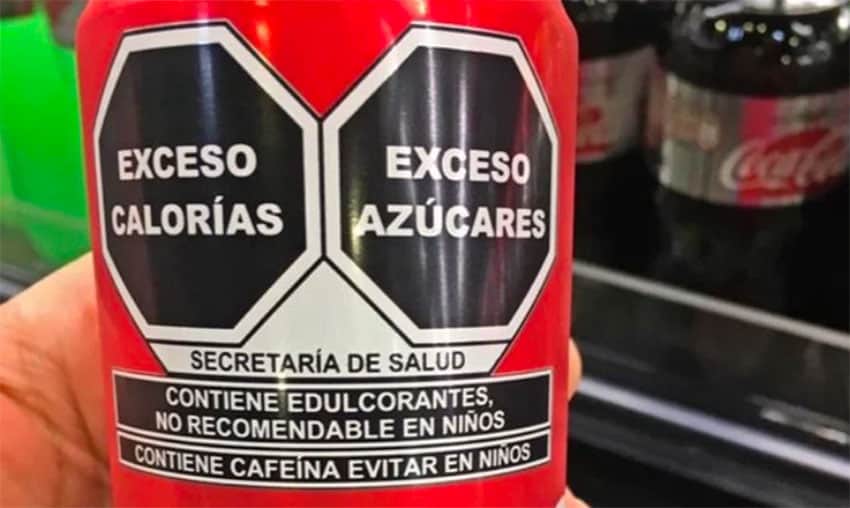
Mexico’s new food warning label law, which requires black informational octagons to be placed on packaged foods that are high in saturated fat, trans fat, sugar, sodium or calories, went into effect on Thursday.
Businesses have until December 1 to phase in the new warning labels to avoid fines.
In addition, the law states that products containing caffeine and sweeteners must bear warning labels indicating that they should not be consumed by children, and products with warning labels cannot include children’s characters, animations, cartoons, or images of celebrities, athletes or pets on their packaging.
The aim of the new requirements, similar to programs already in place in Chile, Peru and Uruguay, is to provide Mexicans with information about the food they eat in an effort to curb obesity, diabetes, heart disease and other ailments related to a poor diet.
The Pan American Health Organization (PAHO) praises Mexico’s new labeling system as the best yet. “It has reached the highest level of excellence that we have today. Mexico has become an example for the world in this matter,” PAHO official Fabio da Silva Gomes said.
Simón Barquera of the Ministry of Health said that a study has shown that the resulting dietary changes would represent “a savings of US $1.8 billion in health care costs in five years if the effect is sustained, and prevent 1.3 million people from becoming obese.” The government says the new program will reduce daily consumption by 37 calories per person.
In Chile, the Ministry of Health reported significant achievements in 2019, three years after implementing its labeling program. Purchases of sugary drinks dropped 25%, packaged desserts 17% and breakfast cereals 14%. An average reduction of 25% in the consumption of sugar was also noted.

The new warnings will not replace the traditional nutrient breakdown per portion size usually placed on the back of packages, information which Barquera characterizes as misleading and useless.
“They are not understood and do not allow a quick decision to be made when comparing, in addition, they are based on arbitrary portions. It is one of the worst strategies clearly interfered with by industries with commercial interests,” Barquera says of the familiar labels.
Critics of the new system say the obesity problem is also due to unhealthy yet traditional Mexican street food, an idea health care officials reject, saying that ultra-processed foods, which account for 25% of Mexicans’ diets, are to blame.
PAHO reports the country is fourth in the world in annual sales of ultra-processed foods and beverages per capita, which the United Nations describes as “the engine of the obesity epidemic.”
“If we remove the ultra-processed ones, the traditional Mexican diet is perfect and balanced and complies with the World Health Organization’s recommendations,” PAHO advisor Silva Gomes said.
As for complaints that small businesses will suffer and thousands of jobs will be lost if Mexicans change their eating habits, Barquera said that won’t be the case. “In Chile, there were no economic problems. The reason is that the consumer continues to buy, only that a change is made to healthier products. Those are the big winners,” he says.
The Mexican Council on the Consumer Products Industry, ConMéxico, agrees that labeling in Chile did not have a major impact on businesses producing unhealthy food, although it questions the efficacy of the program.
“All the products affected at the beginning recovered because the effect was lost, there were so many stamps that the consumer began to ignore them, and they stopped being an element of nutritional information,” its director said.
Source: BBC (sp)