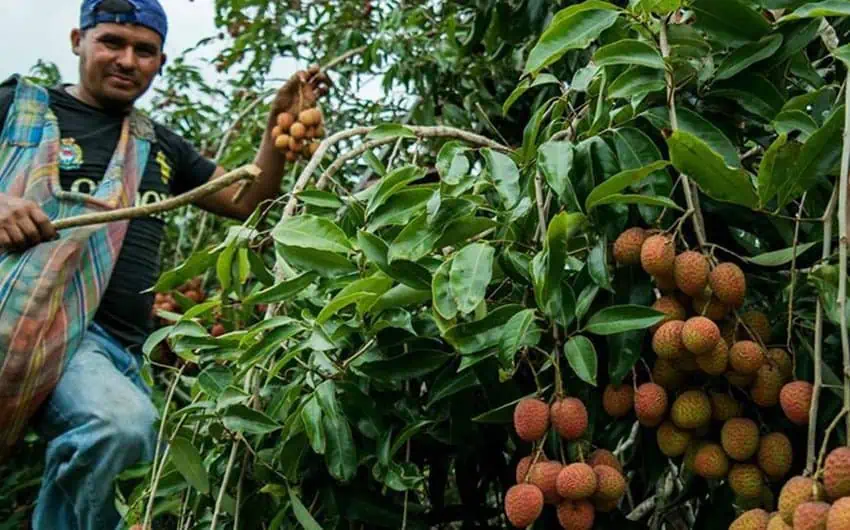
Lychee producers in Oaxaca are betting that demand for their product will continue to grow even though the fruit is rarely consumed in their home state.
There are currently 1,500 hectares of land dedicated to lychee production in the Mixe and Papaloapan Basin regions of the southern state but next year growers forecast they will plant an additional 300 hectares.
Most of their yield goes to the United States, with smaller quantities shipped to other states in Mexico and European countries such as Germany and Spain.
Rafael Torres Rivera, president of a Oaxaca lychee growers’ association, told the news website NVI Noticias that lychees can yield prices of 35 to 40 pesos (US $1.80 to $2.10) a kilo in the United States whereas locally they sell for just eight to 10 pesos.
He explained that producers in Oaxaca harvest their crops in April and May, which is earlier than other lychee-producing states including Veracruz, Puebla, San Luis Potosí, Jalisco and Sinaloa.
“[The fact] that Oaxaca is the first state in the country to produce [lychees] during the year helps us to position ourselves in the market,” Torres said.
Yields were particularly good this year, with some growers harvesting up to eight tonnes of lychees per hectare compared to yields which dropped to as low as two tonnes per hectare in recent years.

However, Torres said that only 700 of the 1,500 hectares of lychee trees are currently producing because the other 800 hectares were only planted recently and the trees haven’t yet matured.
Apart from planting more trees, producers also hope to increase profits by harvesting even bigger bumper crops and by diversifying the use of their lychees.
“The goals are to surpass eight to 10 tonnes harvested per hectare, to work on the added value of the fruit [by producing] jams and dried lychees but also to plant 80,000 trees on another 300 hectares,” Torres said.
Growers are also increasingly producing lychees using only organic fertilizers.
Lychee trees, which are native to China, were first planted in Oaxaca 24 years ago.
Source: NVI Noticias (sp)