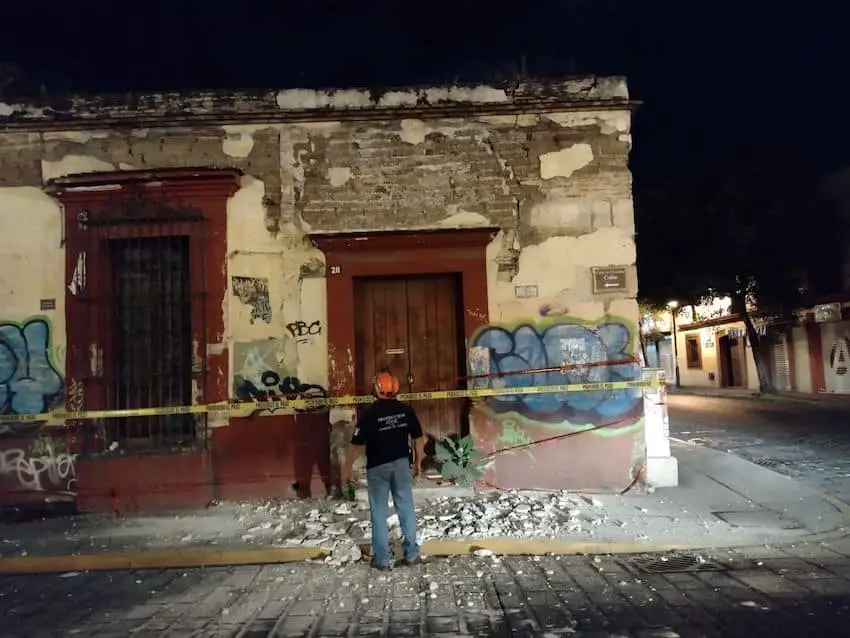
An earthquake in Oaxaca on Friday night was felt all the way in Mexico City, but fortunately caused no casualties and only minimal damage in the coastal state.
The 6.0-magnitude earthquake happened just after 11 p.m. on Friday, with an epicenter 13 kilometers (8 miles) northwest of Matias Romero, in the state of Oaxaca. It was felt most strongly in the Isthmus of Tehuantepec and the Central Valleys of Oaxaca, including the state capital, located 339 kilometers (210 miles) west of the epicenter.

“Civil protection protocols have been activated and our staff are reviewing the possible effects throughout the state,” Governor Salomón Jara told residents. “We ask you to remain calm and alert to official instructions.”
According to preliminary reports, the quake caused minor damage to roads, churches and markets in the region. This included landslides and rockfalls on the road between the state capital and the epicenter; damage to the capital’s 20 de Noviembre market; and the collapse of an awning in the church of San Sebastián Tutla.
The historic center of Oaxaca city was plunged into blackout, and locals shared photos of damage on social media, including collapsed traffic lights and cracks in the Tlalixtac bridge. Aftershocks were also felt in various regions of Chiapas.
As the quake hit, alarms operated by the Mexican Seismic Alert System (SASMEX) sounded in Mexico City. This triggered emergency protocols including safety reviews of the transport and water systems, hospitals being put on alert, and helicopter patrols.
Although tremors of varying strengths were felt in some parts of CDMX, no structural damage or serious injuries were reported.

With reports from El Universal and Infobae