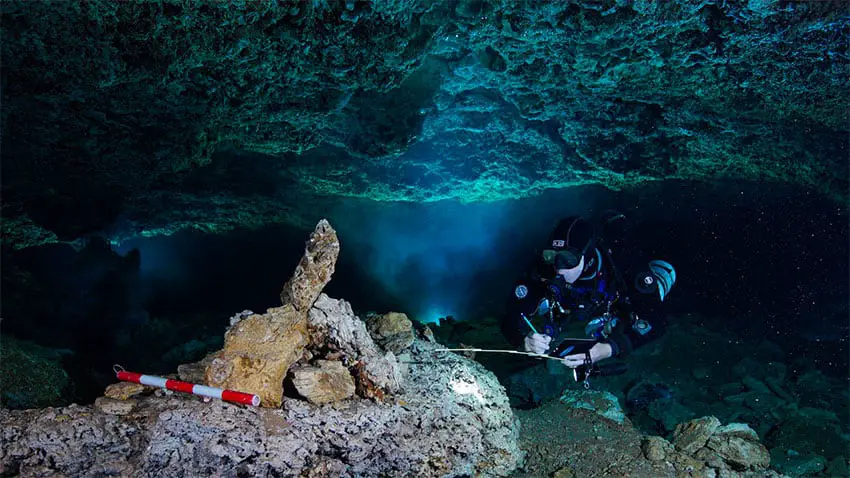
Divers have rediscovered an ocher mine in a submerged coastal cave system in Tulum, Quintana Roo, that is more than 10,000 years old.
Two cave divers from the Quintana Roo Aquifer System Research Center (CINDAQ), Sam Meacham and Fred Devos, located the mine in 2017 and showed it to Eduard Reinhardt, a geoarchaeologist at McMaster University in Canada, the following year.
The three men concluded that ocher – an earthy yellow, red or brown-colored substance used for a variety of purposes including rock art, body painting, the tanning of animal hides and possibly as a medicine – was mined in the now-submerged cave system thousands of years ago.
Radiocarbon dating confirmed that the earliest deposits of ocher were left there some 12,000 years ago while the most recent deposits originated about 10,000 years ago. Rising seas inundated the three-cave system approximately 7,000 years ago but by that time it is believed that the mine had already been abandoned for several millennia.
Dubbed La Mina (The Mine), the site is one of the oldest known ocher mines in the Western Hemisphere.
A research article published in the journal Science Advances on Friday details the rediscovery of the mine and the academic implications.
“The cave’s landscape has been noticeably altered, which leads us to believe that prehistoric humans extracted tonnes of ocher from it, maybe having to light fire pits to illuminate the space,” Devos said.

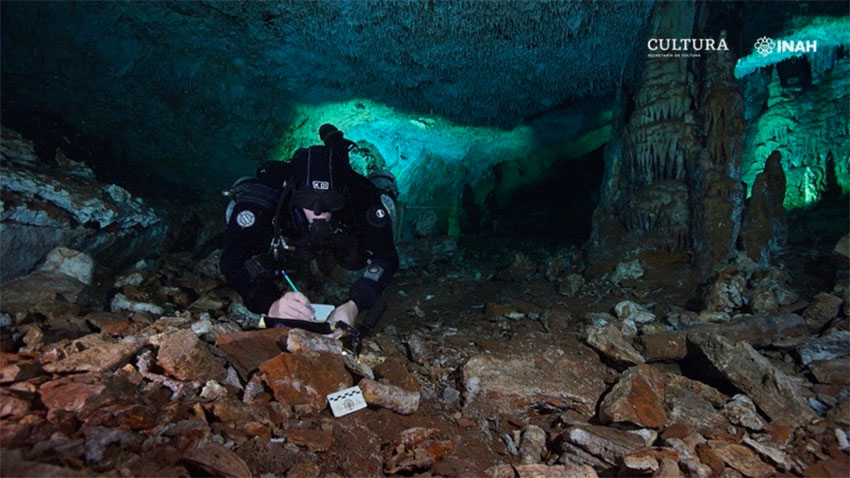
The divers found piles of coal on the floor of the caves and soot on the ceiling, indicating that fires were once lit there.
Brandi MacDonald, an archaeological researcher at the University of Missouri and lead author of the research article, said that there is evidence that ancient miners broke stalactites off the ceiling of the cave system and used them as tools to smash through limestone and extract high-quality ocher.
MacDonald said that there is no conclusive evidence that indicates how the ancient miners used the ocher, explaining that the hot and humid climate has corroded archaeological clues.
However, she said that the ocher’s unusually high arsenic content could have made it an effective insect repellant.
MacDonald also suggested that it was used for decoration, a hypothesis shared by a University of Wyoming archaeologist who is excavating an ocher deposit in that state.
“The love of shiny red things is a pretty universal human trait. … It’s why we buy red sports cars,” Spencer Pelton told Science magazine.
Roberto Junco, head of the Underwater Archaeology Department (SAS) at the National Institute of Anthropology and History (INAH), said that La Mina is a continuation of the Hoyo Negro, or Black Hole underwater chamber, where the skeleton of a teenage female known as “Naia” was discovered in 2007.
Experts have concluded that early inhabitants of the Yucatán Peninsula entered cave systems to search for water and to take shelter from predators. The discovery of La Mina indicates that they had another reason to go inside.
“We can now imagine ‘Naia’ entering the caves in search of ocher, an element that to this day is the most widely used inorganic body paint amongst African communities to create a red pigment,” Junco said.
“This opens up the possibility that the mineral not only had an ornamental value, but also a significance in terms of identity, or that it was used to create artistic manifestations, amongst many other hypotheses.”
INAH said in a statement that experts from Mexico, the United States and Canada will continue to conduct laboratory research in coming months to learn more about the mine and the cave system in which it is located.
Dominique Rissolo, an archaeology researcher at the University of California in San Diego and one of the research article authors, said that a 3D model of the site was created from more than 20,000 photos that were taken during almost 100 dives.
The model allows archaeologists to continue exploring the site virtually without getting wet.
“The team of explorers and researchers assembled for this project is delivering outstanding results,” Junco said.
“The SAS acknowledges … the work of each and every one of them, especially the explorers from the CINDAQ, and their commitment towards the underwater cultural heritage of Mexico.”
Source: Science (en)