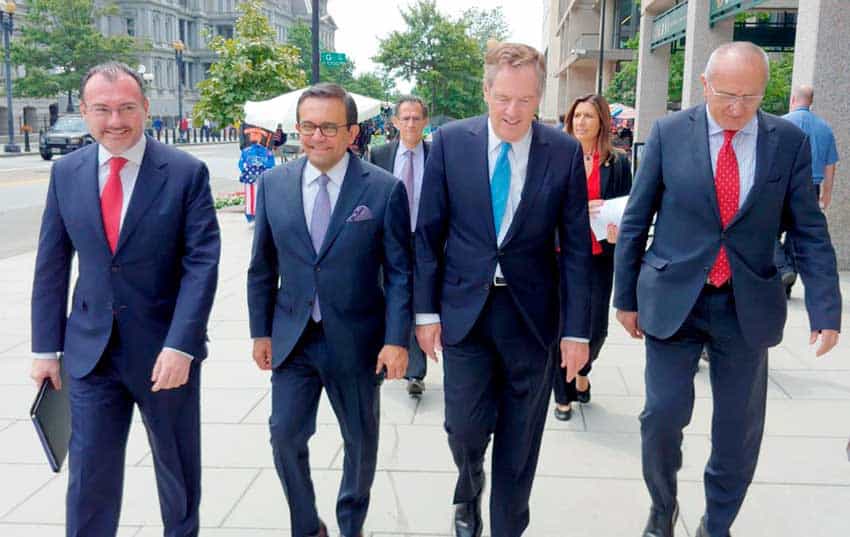
President Enrique Peña Nieto is optimistic that an updated North American Free Trade Agreement (NAFTA) could be reached in August after Mexican and United States officials agreed Thursday to step up talks.
Speaking at an industry event in Mexico City yesterday, Peña Nieto said there is “frankly a very promising horizon” with regard to concluding a deal in the short term.
“We are determined to speed up [the negotiations] in order to make progress in a significant way throughout the month of August. It’s not a deadline but we are convinced that we can reach an agreement,” the president said.
Peña Nieto also said that including members of president-elect Andrés Manuel López Obrador’s transition team in the NAFTA renegotiation process created an atmosphere of both calm and confidence both domestically and in the United States and Canada.
Jesús Seade, whom López Obrador has tapped to be his chief trade negotiator, accompanied Economy Secretary Ildefonso Guajardo and Foreign Affairs Secretary Luis Videgaray to Washington D.C. this week for talks with United States Trade Representative Robert Lighthizer.
“. . . Presenting a single negotiating front with the United States and Canada, I believe creates conditions of greater tranquility but above all confidence in the agreements that we will eventually have,” Peña Nieto said.
Guajardo described the talks with Lighthizer and senior White House adviser Jared Kushner as “constructive” and “very positive.”

With regard to the outstanding contentious issues the economy secretary said, “I think we have agreed on the process and the method to start solving from the less complex to the most complex issues.”
Guajardo and Lighthizer agreed Thursday to quicken the pace of talks with the goal of reaching an agreement in principle next month, which will mark one year since the renegotiation process began.
A joint statement issued by the secretariats of economy and foreign affairs yesterday said that “the teams of both countries will continue working during the coming days in preparation for the upcoming ministerial meeting.”
Trilateral talks stalled in the lead-up to the Mexican presidential election and were complicated further by the United States imposing metal tariffs on both Mexico and Canada from June 1.
Both countries responded with their own tit-for-tat measures, which in Mexico’s case included duties on United States pork, apples, potatoes, Kentucky bourbon and some cheeses and steel products, among other goods.
However, the president of Mexico’s influential Business Coordinating Council (CCE) said yesterday that Mexico and the United States agree that if a new NAFTA deal is successfully reached, the tariffs each country has imposed on the other will be withdrawn.
“. . . The tariffs on [Mexican] steel and aluminum could end soon if we reach an agreement. It would be, let’s say, a deal between both countries, in the case of a trilateral agreement being reached,” Juan Pablo Castañón said.
Following a meeting with Guajardo in Washington, he also said that Mexico is seeking an end to the United States auto probe that could lead to new tariffs on Mexican-made vehicles.
Of the 30 NAFTA chapters, Guajardo said Thursday that negotiators had completed nine and 10 others are almost finished.
One key sticking point that still needs to be resolved, however, is the so-called sunset clause that would see the 24-year-old trade treaty automatically expire if the three countries don’t renegotiate an updated deal at five-year intervals.
The United States has been pushing for its inclusion but both Mexico and Canada remain opposed to it.
Asked yesterday whether Canadian Foreign Affairs Secretary Chrystia Freeland will join the talks, Guajardo said: “What I am expecting is that we have to engage with Canada, either two bilaterals, one trilateral, whatever we agree to.”
The economy secretary met with Freeland in Mexico City Wednesday and both insisted that NAFTA remain a three-way pact amid continuing speculation fanned by United States President Donald Trump that the U.S. could seek separate trade deals with its two neighbors.
López Obrador, who will be sworn in as president on December 1, has also said that he wants NAFTA to remain a trilateral pact.
In a letter sent to Trump this month, he called for a swift conclusion to the negotiations while in a return missive, Trump said that he too wanted a quick deal, adding “otherwise I must go a much different route.”
Source: Milenio (sp), El Universal (sp)