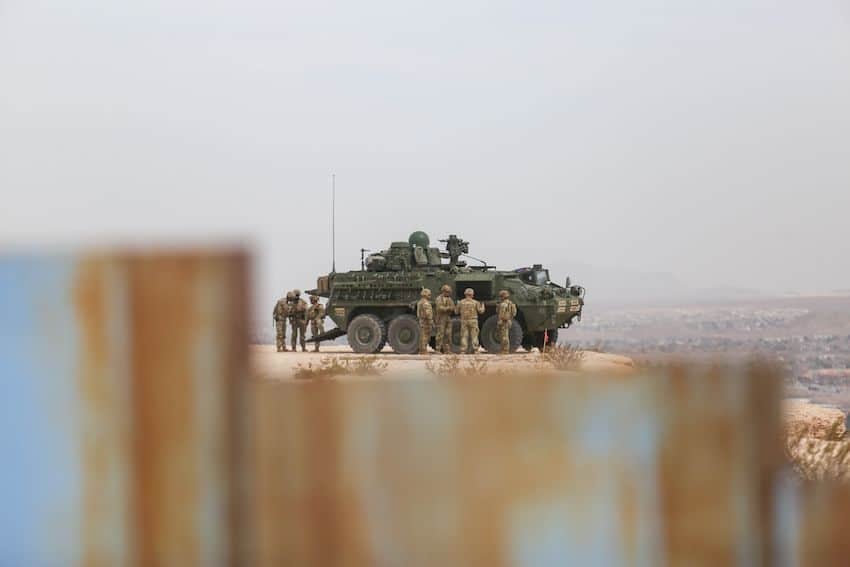
Early Saturday morning, United States President Donald Trump announced that the U.S. had carried out a large-scale military operation in Venezuela, capturing President Nicolás Maduro and his wife.
Speaking after the attack, Trump stated, “We’re going to run the country until such time as we can do a safe, proper and judicious transition.”
Such dramatic moves follow Trump’s rhetoric since retaking the presidency, centered on reviving American interventionism and expansionism. In recent months, Trump has called Canada “the 51st state,” threatened Mexico with military incursions, renamed the Gulf of Mexico the “Gulf of America,” and even suggested that the United States should acquire Greenland and the Panama Canal.
At the start of his second administration, when asked at a Mar-a-Lago press conference whether he would rule out using military force to seize Greenland or the Panama Canal, Trump replied, “I’m not going to commit to that.” Trump went on, “It might be that you’ll have to do something.” In Venezuela, Trump has now acted “to do something.”
But America’s leaders and people should consider the long-term consequences of such actions. As a historian of U.S. expansionism and the U.S.-Mexico border, I have studied how such ambitions have come at a great cost — to Americans, their neighbors and Indigenous populations.
In 1845, President James K. Polk embraced a similar vision for territorial expansion. He supported the annexation of Texas, then controlled by pro-slavery Anglo-American settlers who had declared independence from Mexico, which prohibited slavery. Intending to expand the United States, Polk sent U.S. troops across the Nueces River, the historical boundary of Texas, southward towards the Rio Grande.
Polk insisted the Rio Grande was the actual boundary between the United States and Mexico. After Mexican troops attacked American troops within territory Mexico considered its own, Polk asserted, “Mexico has passed the boundary of the United States, has invaded our territory, and shed American blood upon the American soil.” He successfully pressured Congress to declare war. The U.S.-Mexico War (1846-1848) became the United States’ first full-scale invasion of another nation-state.

Politicians, journalists and popular writers justified the war with interventionist propaganda, depicting the United States as a force for enlightenment and economic development. They even framed the United States as protecting Mexican people against Native American hostilities, arguing that Mexico had not been able to subdue Indigenous people in its northern territories. In the language of the time, Senator Robert Walker (D-Miss.) helped set the discourse in 1836, declaring that Anglo-Americans were invited to settle in Texas to “defend the Mexicans against the then frequent incursions of a savage foe.”
By land and sea, the United States conquered Mexico and occupied its capital for the better part of a year. But we should not overlook that, for the United States, the war resulted in one of the highest casualty rates of any conflict. Of the 79,000 soldiers who served, over 16% lost their lives in battle or due to disease. With more than 8% of soldiers abandoning their posts, the U.S.-Mexico War also had the highest desertion rate of any American conflict.
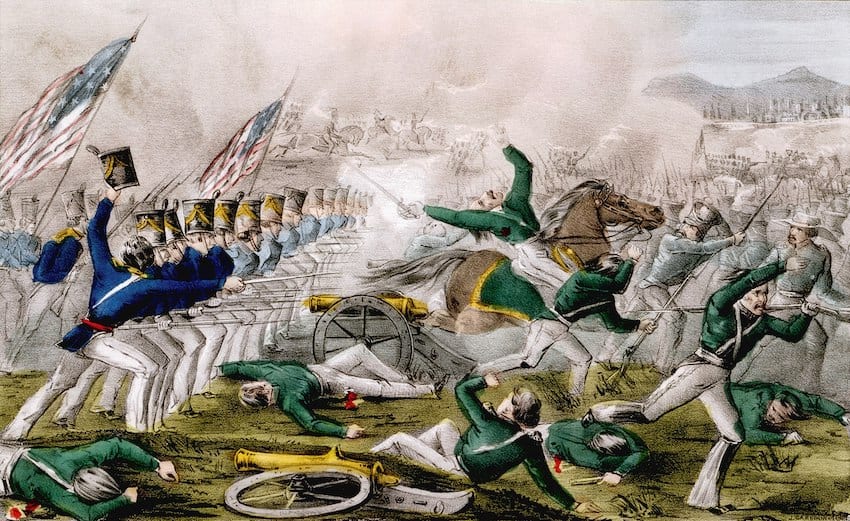
For Mexico, the war was catastrophic. At least 25,000 Mexican people — mainly civilians — died. In the Treaty of Guadalupe Hidalgo, which ended the war, Mexico ceded 55% of its claimed national territory: what is now the U.S. Southwest and more.
The treaty’s Article XI did stipulate that the United States would prevent Native American raiders from entering Mexico. But guarantees to subdue Indigenous populations and bring peace to the Mexican people proved hollow.
After the war, Native American resistance intensified, challenging the United States’ ability to govern its newly claimed lands and borders. On newly American-claimed soil, populations that were now Mexican-Americans engaged with Navajos in a cycle of raids and counterraids in New Mexico. In Texas, Comanches and Mexican Americans continued to attack one another. Native Americans also continued southward raids deep into Mexico, freely crossing the new border. The United States could not live up to its promises of peace or its treaty obligations. It could not better the lives of Mexican people or mount sufficient force to subdue Native American populations that fought to maintain their independence.
The United States’ inability to fulfill its treaty obligation revealed the limits of American power. Expansion did not bring stability or prosperity to occupied lands; instead, it often left further chaos.
As Trump restarts American interventionism and expansionism, Americans should grapple with the past.
Such actions often overextend the military and come at the cost of life for both the occupiers and the occupied. As history shows, threatening — or worse, invading — Greenland, Panama, Canada, Mexico and Venezuela risks straining U.S. military capabilities and provoking resistance.
The United States’ first invasion of another nation-state plainly demonstrates that American expansionism is a cautionary story from our past. It is up to us to ensure it remains so.
Joel Zapata is an Assistant Professor and the Cairns K. Smith Faculty Scholar at Oregon State University