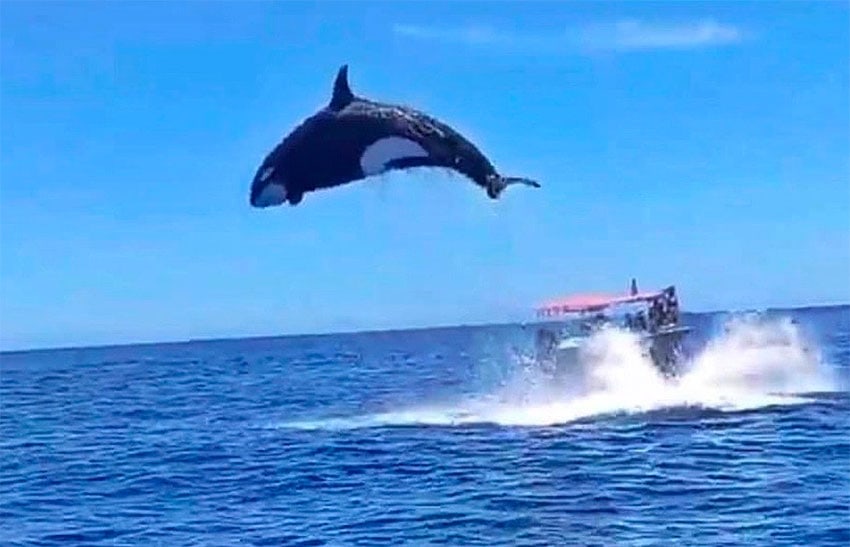
An orca’s dramatic attack against a bottlenose dolphin on Sunday was captured on camera in the Sea of Cortés.
The video shows an orca launch itself five meters into the air in a vertical charge to collide with a dolphin, which is already unbalanced in mid-flight.
The dolphin, a fraction of the orca’s size, is thrown aside as the attacker continues its trajectory skyward, completing a graceful arc to the delight of onlookers.
Expressions of astonishment and excited shouts of “No way” can be heard immediately after the collision.
The event occurred after several boats had gathered to view an orca pod as it hunted dolphins.

The footage was caught by diver Miguel Cuevas of Cabo Pulmo Divers near Cabo Pulmo National Park, Baja California Sur. The dive center described the leap as an “amazing moment.”
From the same excursion, underwater footage shows a bottlenose dolphin being chased by the much larger orcas.
Cuevas said he estimated the height of the leap to be “four to five meters” and counted “at least 10 orcas,” all females. He added that the hunting lasted several hours and involved one kill.
Researchers have tried to obtain more information about the encounter, and to determine whether any males accompanied the pod.
Eastern tropical pacific orcas, or killer whales, prey largely on marine mammals and mobula rays, which are abundant in the Gulf of California. The orcas are known to express curiosity toward boaters and to occasionally surf in vessels’ wakes.
The name “killer whale” is a misnomer, in that killer whales are actually a type of dolphin.
The predators hunt in packs, and feed on other dolphins, seals, walruses and fish. They have been known to hunt down and kill minke whales, grey whales, sperm whales and even blue whales.
Sources: USA Today, 9 News