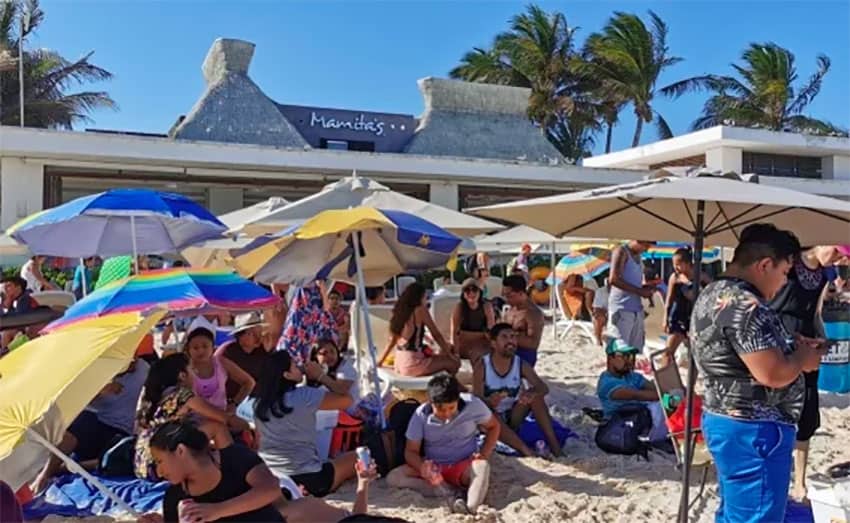
As many as 1,200 people gathered outside a beach club in Playa del Carmen, Quintana Roo, on Sunday to protest the infringement of citizens’ access to the country’s beaches.
The protest was held in response to last week’s arrest of a couple who had refused to buy food and drinks from Mamita’s Beach Club. The club’s management claim its staff called police because the couple was occupying a service route on the beach.
Users on social media organized the picnic/protest after a video of the couple’s arrest went viral. Azeneth Marín can be seen in the video crying and telling officers of the tourist police that they are hurting her.
Attendees of Sunday’s protest occupied the space in front of Mamita’s Beach Club and even used the establishment’s beach chairs and parasols.
“Grab what you want. Today it’s all free,” shouted men who had come to the protest.
Local and foreign residents alike gathered to make the statement that Mexico’s beaches are open to the public and access to them cannot be controlled by private businesses.
“I was born and raised here. My family has also been run off this beach,” said Martha Enríquez, 60, who came from the neighboring town of Puerto Morelos to join the demonstration.

“We came today to tell them that these beautiful places also belong to us, to our children and our grandchildren,” she said.
Others spoke of similar incidents that have occurred elsewhere on Mexico’s Caribbean coast, in places like Puerto Aventuras, Akumal and Puerto Morelos.
Mamita’s Beach Club released a public apology after the arrest of Azeneth Marín and her boyfriend on February 16, and was even reported to have provided free fruit and water to Sunday’s partying protesters.
The online condemnation of the actions taken by the club and police prompted an official apology from the municipal government of Solidaridad, in which Playa del Carmen is located. Mayor Laura Beristain Navarrete publicly apologized to the couple last Wednesday.
Article 8 of the Mexican constitution states that access to the country’s beaches cannot be inhibited, restricted, obstructed or controlled by a private or government entity, save for conservation or military purposes.
Sources: El Universal (sp), Sipse (sp)