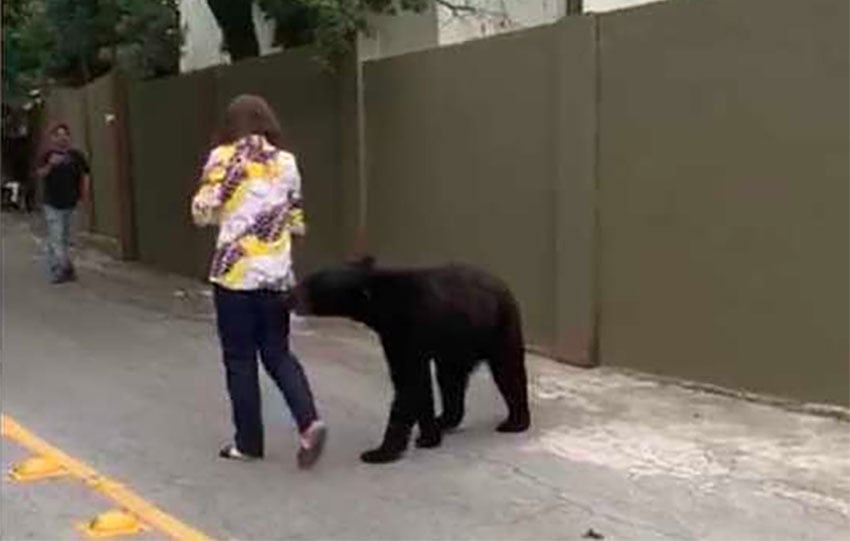
A black bear had another close encounter with a woman in Nuevo León’s Cerro de Chipinque Ecological Park, where such interactions with humans are occurring on an increasingly frequent basis.
In a video clip of Tuesday’s incident, a woman is approached by the medium-sized bear who sniffs her and lightly paws at her while her husband films the scene, urging her to stay calm. “What should I do?” the woman asks the man, who replies, “Don’t move, stay there.”
The man remarks that the bear appears very playful, but the tension in his voice escalates as the bear grabs the woman’s leg with its paw. “Bear, bear, come here,” the man says before the clip ends.
Over the weekend the same bear, recognizable by a tag in its ear, approached a small group of women who were running in the same area, standing up on its hind legs at one point to smell a woman’s hair as she snapped a selfie.
“This type of approach by the black bear to the visitor is abnormal behavior caused by human beings,” said representatives from the park in a statement. “The interaction shown in the video should have been avoided; what is recommended is to move away when detecting the presence of the bear and not approach.”
#NL | Oso sigue a mujer mientras caminaba en calles de San Pedro https://t.co/XY3K7XxY32 pic.twitter.com/fddKEhHIeA
— Milenio Monterrey (@MilenioMty) July 21, 2020

The bear in question has already been captured twice and released at the request of neighbors, the park said, but as the animal appears to have lost all fear of humans, it will need to be recaptured and sent either to a zoo or an area less populated by people.
Gustavo Treviño, general director of Parks and Wildlife in Nuevo León, told the newspaper Milenio that 26 bear sightings have been reported in the municipalities of San Pedro, Santa Catarina and Monterrey. He urged citizens to avoid all contact with them and not to feed them or take photos.
“The natural behavior of a bear toward people is always to run away. What we have seen in the videos is what we call totally aberrant behavior; it is no longer a natural behavior of a bear and can lead to aggressive behavior and pose a risk to the safety of people,” said Rogelio Carrera Treviño, coordinator of the wildlife laboratory at the Faculty of Veterinary Medicine and Animal Husbandry at the Autonomous University of Nuevo León (UANL).
He noted that the bear in the videos is a young adult between 3 and 4 years old that learned from its mother that humans can be a source of food.
Yelling or making noise is the best way to scare off a bear, which is Mexico’s largest carnivore. “It is a predator that can be dangerous, it is a wild animal and its behavior can be unpredictable, that’s why we must keep distance,” Carrera said.
The black bear is an endangered species and is protected in Mexico, which is why it will be sent to a zoo or wildlife center. In the United States bears that exhibit this kind of familiarity with humans are often euthanized.
Source: Milenio (sp), Yahoo Noticias (sp)