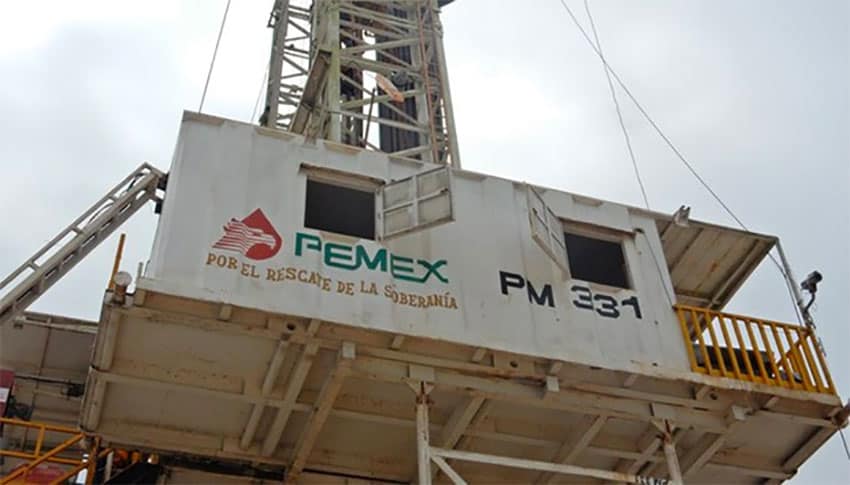
Pemex has found an onshore oil field in Veracruz that could contain as many as 5 billion barrels of crude oil and natural gas.
State oil company sources told the newspaper El Universal that the mega-deposit is potentially one of the biggest oil discoveries in recent years, stating that it likely contains much larger reserves than Zama, a shallow-water field in the Gulf of Mexico that was discovered by a private consortium of companies in 2017.
The unnamed sources said that the newly discovered Kuxum field, which extends across 200 kilometers of land in the Gulf coast state, has the potential to turn around the fortunes of the heavily indebted state oil company, whose output has been on the wane for more than a decade.
The discovery of the field comes just two months after Pemex announced that it had found a huge oil deposit in Tabasco that could yield 500 million barrels of crude.
Pemex is also seeking control over the Zama field, CEO Octavio Romero said in late January. He said the state oil company believes that most of the crude found is in an adjacent block where Pemex has development rights, declaring that the reservoir is “shared.”
In light of the new discoveries, the oil company sources told El Universal that Pemex’s oil production could reach 2 million barrels per day (bpd) by December 2020 – 100,000 bpd more than a prediction made by Romero last month.
Meanwhile, Italian oil company Eni announced that it has discovered a reserve in the Gulf of Mexico that is believed to contain between 200 and 300 million barrels of crude.

Located 65 kilometers off the Veracruz coast, the Saasken-1 well is the sixth consecutive well drilled by Eni that has been successful in finding oil. The well appears to have the capacity to yield 10,000 bpd of crude, the company said.
Eni, one of several foreign companies that bought drilling rights at oil and gas auctions held after the previous government ended Pemex’s almost 80-year monopoly in the sector, said in 2018 that it expected to invest almost US $1.8 billion in three Gulf of Mexico oil fields by 2040.
Source: El Universal (sp), Milenio (sp)