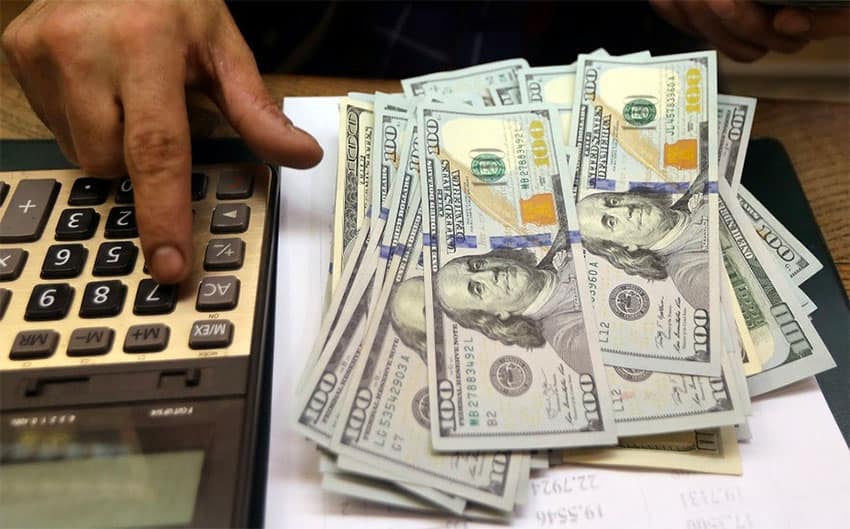
The Mexican peso fell to a record low in relation to the United States dollar early Thursday, registering at 22.98 in international trading.
The declaration by the World Health Organization on Wednesday that novel coronavirus Covid-19 is a global pandemic sparked a wave of panic selling of the peso, which also took a hit earlier this week after global oil prices slumped due to a price war between Saudi Arabia and Russia.
Before Thursday’s record low, the peso was at its weakest on January 18, 2017 when one dollar bought 22.25 pesos, 3.3% less than the 22.98 rate.
The more than 6% decline in the value of the peso in early morning trading came despite this week’s decision by the Exchange Commission – a body made up of representatives from the central bank and the Finance Ministry (SHCP) – to ramp up a three-year-old currency hedging program.
The Bank of México and the SHCP said in a statement Monday that the commission “has decided to increase the size of the currency hedging program for the equivalent in local currency of US $20 billion to $30 billion.”
“The Exchange Commission reiterates its commitment to continuing to evaluate the foreign exchange market operating conditions and to taking additional measures, if necessary,” the statement added.
After this morning’s slump to almost 23 pesos to the dollar, the interbank rate for the Mexican currency recovered to 22.12, the newspaper Milenio reported. According to currency exchange website xe.com, a single greenback was buying 21.93 pesos at 11:00 a.m.
Juan Francisco Caudillo, an analyst at the Monex financial group, said this week that 25 pesos to the dollar is possible in an extreme case in 2020. He said that the worst-case-scenario estimate took into account factors including the oil price slump, the impact of coronavirus on the United States – Mexico’s largest trading partner – and this year’s U.S. presidential election.
More widely, investors are increasingly concerned about whether the efforts of governments around the world to stimulate their economies in the face of the growing spread of Covid-19 will be sufficient to stave off recession.
U.S. President Donald Trump’s decision to suspend all travel from continental Europe to the U.S. for a period of 30 days starting Friday is predicted to have a massive financial cost.
Stock markets around the world have fallen as the number of coronavirus cases and deaths continue to climb. The Mexican Stock Exchange’s benchmark IPC index fell 9.18% on Thursday morning, the biggest single-day decline since September 1998.
Source: El Universal (sp), Financial Times (en), Milenio (sp), El Financiero (sp)