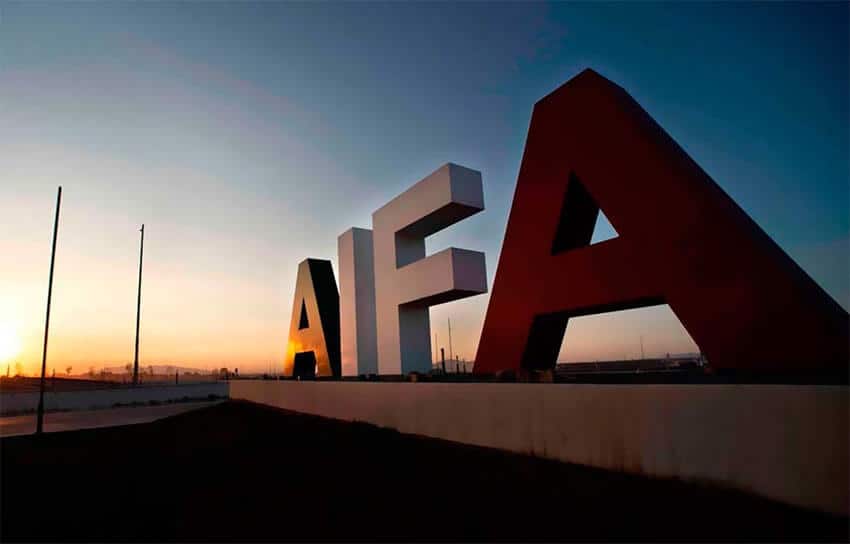
The opening of the Felipe Ángeles International Airport (AIFA) is apparently causing problems for air traffic controllers at the Mexico City International Airport (AICM), leading an international pilots’ federation to raise safety concerns.
The International Federation of Air Line Pilots’ Associations (IFALPA) issued a safety bulletin advising that in the past month it has been made aware of several incidents involving aircraft arriving at the AICM with “low fuel states due to unplanned holding, diversions for excessive delays, and significant GPWS alerts where one crew almost had a controlled flight into terrain.”
A GPWS alert is a ground proximity warning system alert in which pilots are warned they are in imminent danger of flying into the ground or an obstacle.
IFALPA said that with the opening of the AIFA – which began operations on March 21, albeit with a limited number of flights – it would appear that air traffic controllers at the AICM have received “little training and support” as to how to direct flights operating in the new airspace configuration.
AIFA, a mixed civil/military airport built on an Air Force base in México state, is just 40 kilometers north of the AICM.
New Safety Bulletin: https://t.co/icuZG4BvDA on Mexico City International Airport (MMMX) #aviationsafety pic.twitter.com/tx6ESr3e8f
— IFALPA (@IFALPA) May 4, 2022

IFALPA said that crews flying into the latter airport “have received clearances that do not adhere to terrain avoidance restrictions” in accordance with standard terminal arrival route (STAR) procedures.
It also said that proper International Civil Aviation Organization phraseology is not being used by AICM air traffic controllers, “adding to confusion on altitude restrictions.”
The federation recommended that aircraft flying into Mexico City consider carrying additional fuel to allow for prolonged holding and possible diversions. It also advised airline crews to remember that the AICM is a high altitude airport – Mexico City is over 2,200 meters above sea level – and to be prepared to operate in that environment.
“It is also recommended that crews exercise heightened terrain situational awareness and strictly adhere to published altitude restrictions. If you receive a clearance that you find questionable, resolve the clearance to your satisfaction,” IFALPA advised pilots.
Humberto Gual, secretary-general of the Association of Airline Pilots of Mexico (ASPA), agreed that air traffic controllers at the AICM haven’t had sufficient training.
“Issues in the air have increased … [because], from my point of view, the controllers haven’t had [enough] training,” he told the newspaper El País.
ASPA has requested a meeting with aviation authorities, including Navigation Services for Mexican Airspace (Seneam), to deal with the problems occurring in control towers and the airspace above the AICM.
“Our passengers can be confident that ASPA pilots have the highest standards of … training, and under no circumstances would we compromise your safety,” the association said in a statement.
“… We call on Seneam to attend to the reports of Mexican and foreign pilots, seeking the safety of our air operations first of all and the efficiency of our air space.”
Questions have long been raised about the viability of three central Mexico airports – the AICM, the AIFA and the Toluca International Airport – operating in close proximity to each other, especially once flight numbers increase at the AIFA. But the way in which airspace is used was redesigned to enable their simultaneous operation.