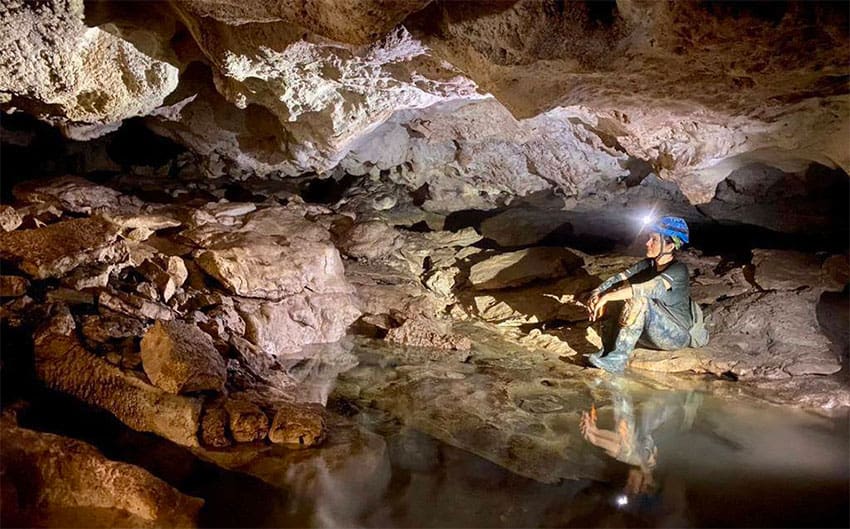
A sinkhole that opened up on the highway between Playa del Carmen and Tulum, Quintana Roo, has exposed a large water-flooded cave filled with the fossils of ancient sea snails and rocks that date back to the Pleistocene era.
Speleologists, or cave explorers, used the Playa del Carmen sinkhole as a portal to enter the cave, which is approximately 60 meters long and eight meters deep.
In addition to 2 1/2-million-year-old sea snail fossils and old rocks, they found crustaceans, mollusks, shrimps and other living creatures in the cave’s crystal-clear water.
The members of the Mayab speleology club also completed studies to make a topographic map of the cave, which is located beneath a stretch of road that will be near the Playa del Carmen-Tulum section of the Maya Train railroad.
They dubbed one section of the cave “Snail’s Heaven” because of the large numbers of sea snail fossils adhered to its walls.
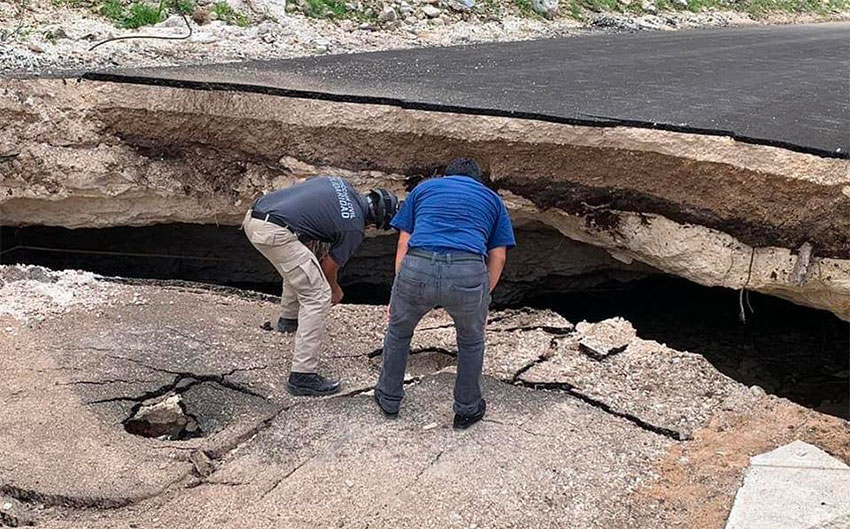
Roberto Rojo, a biologist and speleologist, said that the cave has conduits that allow water from the Caribbean sea to flow into the cave and vice versa. He said that filling in the sinkhole and thus closing off the portal to the cave would be “ecocide.”
Rojo and other experts are preparing a report that will detail the characteristics of the cave and provide recommendations for its conservation.

The Yucatán Peninsula has an elaborate aquifer system that includes thousands of natural sinkholes called cenotes.
Some experts have warned that construction of the Maya Train poses environmental risks to the region’s underground water networks as well as the long-term survival of the jaguar.
Construction of the US $8-billion project started this month and is scheduled for completion in late 2022.
Source: La Jornada (sp), Milenio (sp)