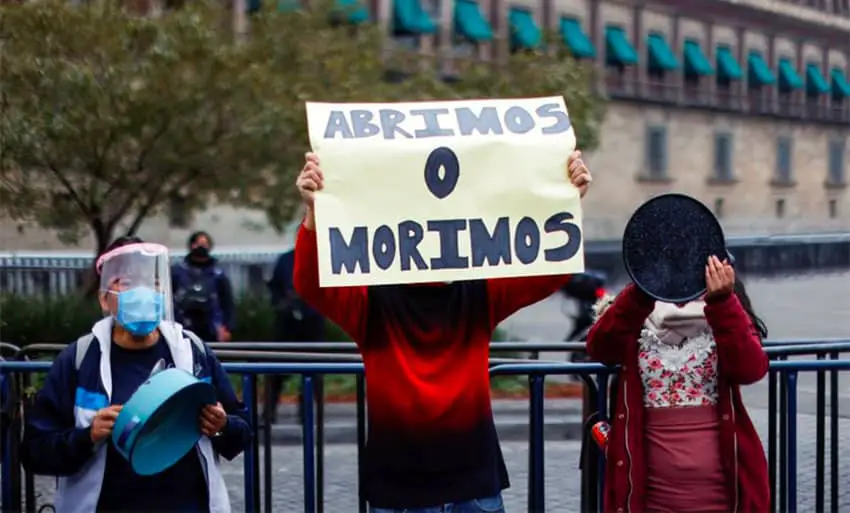
The coronavirus pandemic and the lack of government support to mitigate its economic impact have significantly increased inequality in Mexico, according to a recently formed political organization.
Sí por México, a group of citizens and organizations opposed to the federal government, conducted an analysis using data from the national statistics institute Inegi that found that the gap between the salaries received by the country’s best and worst paid workers almost doubled between March and September.
The incomes of the lowest-paid quintile fell 44% in that period while the earnings of the best-paid 20% only declined by 8%, Sí por México said.
“This means that the distance between the two groups almost doubled,” the organization said, noting that workers in the top quintile earned on average 15 times more than the poorest 20% in March but almost 30 times more in September.
Sí por México said it was regrettable that the federal government didn’t provide more support for small and medium-sized businesses – assistance has been limited to small loans – amid the sharp coronavirus-induced economic downturn. There has been less government support in Mexico than in any other Latin American country with the exception of Nicaragua, the organization said.
Data compiled by the statistics portal Statista shows Mexico had only spent 0.7% of GDP on support for people and businesses struggling financially due to the pandemic as of last October. In contrast, Canada spent 16%, the U.S. 13.2%, Brazil 12% and Argentina 6%.
Miguel Székely, director of the Center for Educational and Social Studies, a think tank, said that the increased inequality precipitated by the coronavirus pandemic is a consequence of the lack of a safety net for the nation’s poorest.

“What we’re seeing now in Mexico is that those who are lowest on the salary scale are those who suffer the most because they’re the one who are fired,” he said.
Székely said that Mexico’s poorest have run out of any savings they might have had and have already pawned all they could pawn.
“They’re hitting rock bottom,” he said, adding that the situation has the potential to cause “social tension.”
Székely condemned the government for not providing financial support for the country’s poorest amid the pandemic – although President López Obrador says they are assisted by his administration’s various welfare and social programs – and called into question its stated commitment to “the poor come first.”
The instinct of a government that uses such a slogan should have been to help that segment of the population but it turned its back of them instead, he said. “Nothing is being done to protect this population,” Székely added.
Source: Reforma (sp)