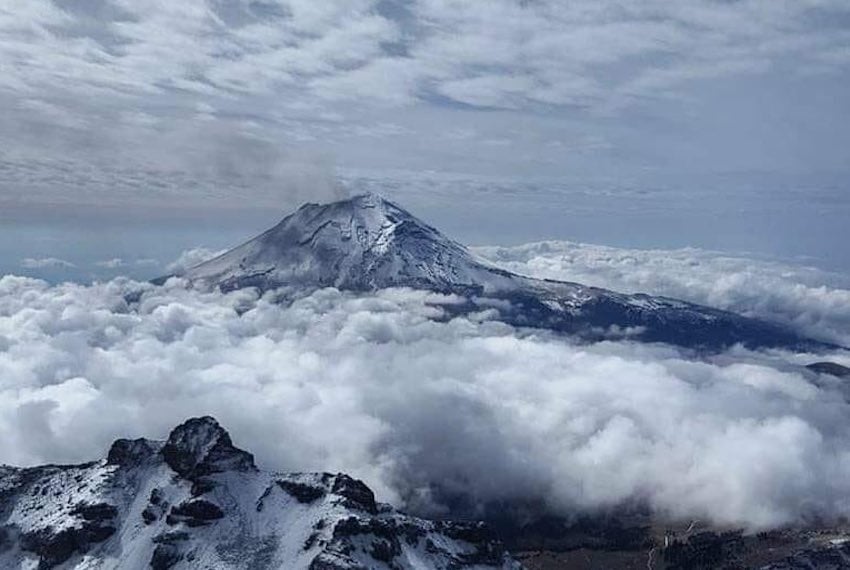
Mexican scientists have produced the first full three-dimensional map of Popocatépetl, one of the world’s most closely watched volcanoes because of the millions of people living nearby in central Mexico.
Researchers from the National Autonomous University of Mexico (UNAM) spent five years hauling instruments up the 5,426-meter (17,802-foot) volcano, deploying 22 seismographs around its flanks to capture and catalog the different kinds of seismic signals.
“I taught the machine about the different types of tremors there are in ‘El Popo,’” said Karina Bernal, a researcher on the project.
The sensors log ground vibrations 100 times per second, feeding artificial-intelligence tools that sort signals and reveal what lies miles beneath the crater.
The resulting tomographic map, extending roughly 11 miles below the summit, replaces the textbook image of a single magma chamber with a far more intricate system.
Scientists report multiple magma pockets at different depths, separated by solid rock, and a mushroom-shaped magmatic structure linked by a narrow conduit that concentrates material beneath the volcano’s southeastern side.


Popocatépetl, often called “Don Goyo” or “El Popo,” has been in an almost continuous phase of activity since 1994, emitting ash, gas and incandescent fragments that can disrupt aviation and dust communities in the country’s most populous corridor.
Some 25 million people live within about 100 kilometers of the crater, including residents near five major airports, underscoring why even modest eruptions draw intense scrutiny from authorities and scientists.
Straddling the borders of the states of Puebla, México and Morelos, Popocatépetl is about 70 kilometers southeast of Mexico City.
Though it’s one of Earth’s most active volcanoes, experts say its greenhouse-gas emissions are still modest compared with human output from Mexico City.
The new 3D imagery joins similar interior maps already made for other high-risk volcanoes in places such as Italy, Japan and the United States.
Researchers say repeating the study in the coming years could show how the magma system evolves — crucial information for refining volcano alerts.
With reports from Associated Press, El Sol de México and Detona