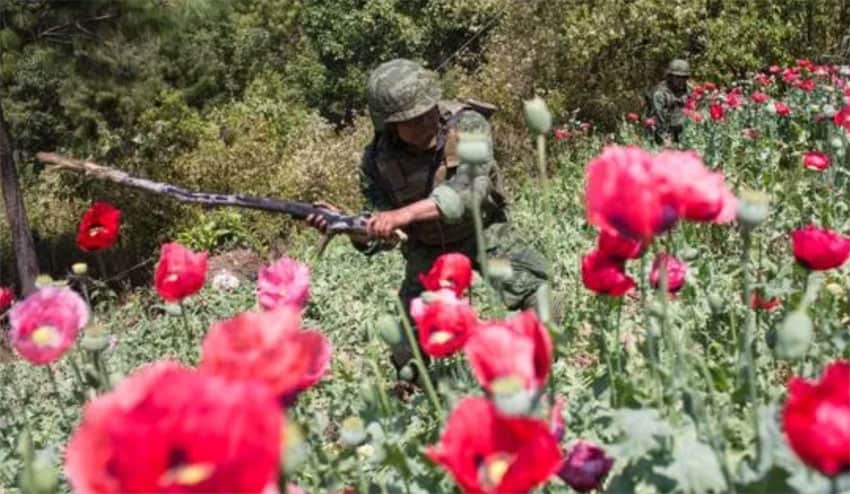
Opium poppy farmers in a Tierra Caliente municipality of Guerrero are demanding that the army stop destroying their crops and leave.
“The soldiers are still here destroying [the crops] and what we want is for them to go,” a San Miguel Totolapan poppy farmer told the newspaper Reforma in a telephone interview.
The farmer said that he and other poppy growers are drawing up a list of demands to be submitted to President López Obrador and Guerrero Governor Héctor Astudillo. First and foremost is the withdrawal of the army from the Sierra section of the Tierra Caliente (hotlands) region.
“We’re going to give the government a few days to attend to us,” the farmer said.
Reforma reported that poppy farmers from seven communities confronted soldiers last weekend after they destroyed 50 hectares of plants. The army has been eradicating poppy crops in Guerrero and states such as Chihuahua, Sinaloa and Durango for years.
Guerrero farmers have appealed to López Obrador to legalize the cultivation of opium poppies for use in the manufacture of legal pharmaceuticals but although there have been signs that the government is open to considering the possibility, that hasn’t occurred.
The price paid for opium paste – the raw ingredient of heroin – has plummeted in recent years due to lower demand brought about by the increasing popularity in the United States of the synthetic opioid fentanyl. The sharp decline in price has left many poppy farmers in a precarious financial situation.

The San Miguel Totolapan farmer said that a kilogram of opium paste currently sells for 8,000 pesos (US $395) while at the start of the previous federal government’s 2012-2018 term, a kilo went for between 25,000 and 30,000 pesos (US $1,235 to $1,485 at today’s exchange rate).
The farmer said the drop in opium prices has forced poppy growers to survive on a very basic diet.
“We have beans, corn and chiles but we can no longer buy meat and milk,” he said. “We’re forgotten here and up until now the government hasn’t given us any support.”
The farmer called on federal and state officials to travel to the Tierra Caliente and speak with ordinary people and local leaders about the problems they face and ways to resolve them.
Source: Reforma (sp)