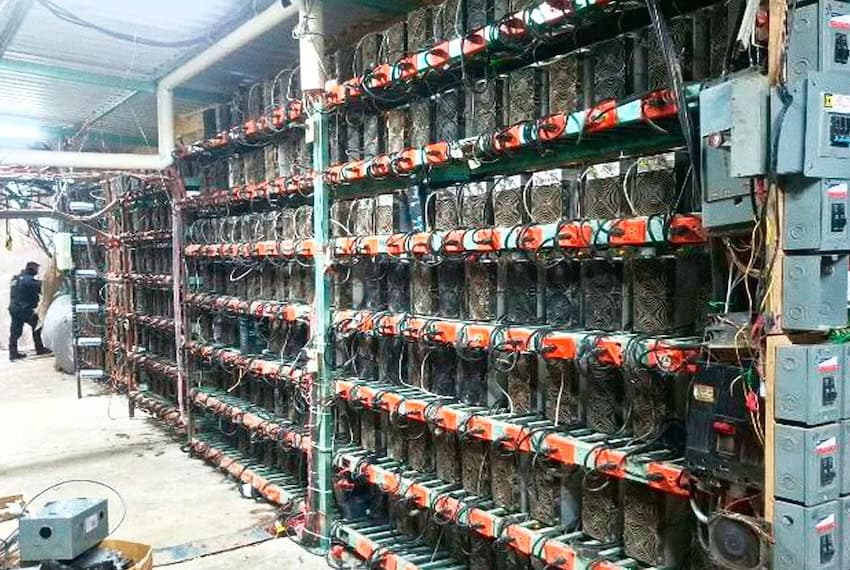
Federal authorities dismantled a clandestine cryptocurrency mining farm in the state of Puebla where approximately 300 computers illegally connected to a hydroelectric complex were found to be mining digital assets.
The cryptomining farm was discovered in Tlaola, a municipality in the remote Sierra Norte region of Puebla, thanks to a joint investigation carried out by the Federal Attorney General’s Office, the Navy and state prosecutors.
En Tlaola, un inmueble presuntamente utilizado para minería de criptomonedas fue asegurado por @FGRMexico, @SEMAR_mx y Seguridad Pública Estatal del @Gob_Puebla.
Se localizó infraestructura eléctrica, internet satelital y equipos especializados en generación de activos… pic.twitter.com/lfgKk3pY3s
— Secretaría de Seguridad Pública (@SSPGobPue) September 6, 2026
During the operation, authorities uncovered a highly equipped digital operations center. Agents seized large-scale electrical and technological infrastructure that included transformers, medium-voltage terminals, 300 specialized computer units (GPUs) and operational satellite internet antennas.
The initial criminal charge being prepared is energy theft, but prosecutors say money laundering charges have not been ruled out. Forensic accountants are tracing the origin of the funds used to acquire the expensive technological hardware.

State authorities have confirmed that investigators have expanded their search to neighboring municipalities in anticipation of similar operations.
Puebla Security Minister Francisco Sánchez said the “farms” are part of a network that takes advantage of the proximity to hydroelectric facilities in the Sierra Norte to steal massive volumes of energy.
Cryptomining consumes a significant amount of energy and produces a lot of noise, Sánchez said, so remote and isolated locations away from communities are favored.
“We have been monitoring this … area of the state, especially due to its proximity to the [Nuevo Necaxa] dam,” he said, adding that the discovery of a large-scale power line connection helped the authorities locate the clandestine farm.
Last year, officials busted a crypto farm in the small Puebla community near the dam where properties owned by the Electrical Workers Union were allegedly being used to operate mining facilities powered by illegal connections to the Federal Electricity Commission (CFE) power grid.
Two other mining operations straddling the border between Puebla and Tlaxcala were also dismantled in 2025.
Cryptocurrency mining — which is not illegal in Mexico, although cryptocurrencies are not legal tender here — is a process that uses computers to solve complex mathematical operations in order to validate transactions and earn rewards in digital assets.
In its latest report on non-technical losses covering the period from January to July 2024, the CFE estimated that energy theft, meter tampering and illegal connections cost the company approximately 13.8 billion pesos (US $817 million).
Cryptocurrencies are increasingly being used to move funds between financial users and countries quickly, cheaply and discreetly, such that they have become a popular money-laundering tool for criminal groups.
With reports from El País, Xataka México, Debate and La Jornada de Oriente