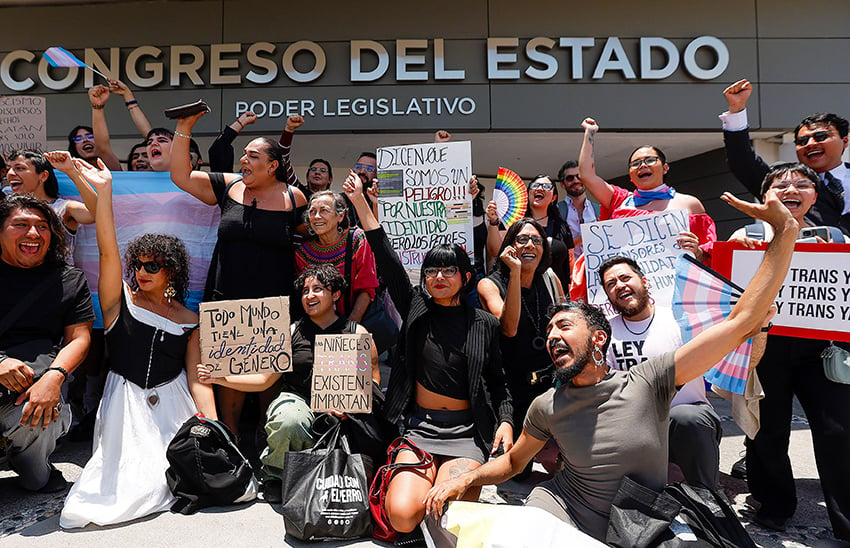
Querétaro’s state governor Mauricio Kuri González announced on Monday that he was vetoing a law that would allow individuals to change their legal gender in Mexico’s Civil Registry, after the law was approved by the state Congress on April 30.
“This law, promoted by the radical left, allows girls and boys… to change their sex on their birth certificate according to their self-perception,” said Kuri, who represents the conservative National Action Party (PAN).
La protección de las niñas y los niños de #Querétaro es una alta prioridad de mi gobierno.
Somos ejemplo nacional en el cumplimiento de esa responsabilidad y lo seguiremos siendo: les informo a las y los queretanos que estoy vetando, conforme a mis facultades constitucionales,… pic.twitter.com/VKv2WkHoV8
— Mauricio Kuri (@makugo) May 26, 2026
Kuri said the reform “goes against the values, education and integrity of Querétaro families … It is an ideological issue that they want to impose on our society.”

Pro-life groups linked to PAN and various religious organizations took to the streets to protest reforms related to gender identity and safe abortion on May 16. While the protest’s organizers said the march was not political, several state government officials attended.
LGBT+ Pride and Dignity March organizers responded to news of the veto in a press release on Monday.
“Mauricio Kuri’s remarks regarding the Gender Identity Law are irresponsible and profoundly regressive,” the release stated. “If the governor is going to make the serious decision to restrict rights, he should do so openly and with verifiable arguments.”
They added that “denying recognition of gender identity protects no one; it only increases violence, exclusion, and institutional abandonment … We will not accept that human rights be subjected to personal prejudices or political calculations.”
Meanwhile, the center-left Morena party representative, Andrea Tovar, told the newspaper La Jornada that she believes that the law’s content has been misrepresented and that the dissemination of incorrect information is worrisome.
“The reality is that this is a law that includes these rights for adults,” Tovar explained. “That is how it was voted on and how it was drafted.”
Tovar added, “We need to continue fighting until dignity becomes the norm.”
The proposed reform, a joint effort between the Querétaro Human Rights Ombudsman’s Office and opposition legislators, would establish an administrative procedure at the Civil Registry for adults to be permitted to change their gender identity in the state, according to Tovar.
To date, 24 Mexican states have already adopted similar reforms.
Separately on Monday, the Supreme Court of Justice of the Nation ruled that parents or guardians subjecting a minor to sexual orientation conversion therapy may be sent to prison.
This was in response to an article in the Guanajuato State Penal Code that allowed for the imposition of a fine and psychotherapeutic treatment rather than prison time, which came into effect in December.
With reports from La Jornada