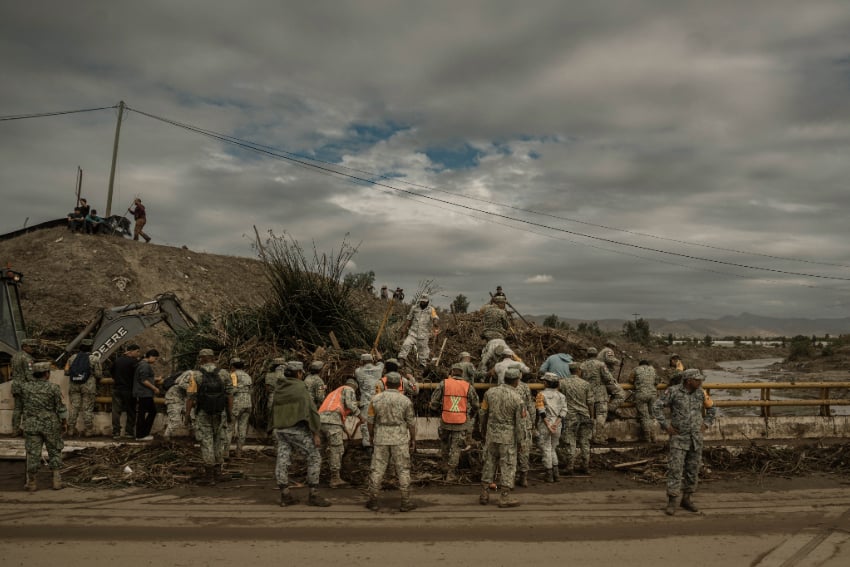
While Pacific Coast residents are still reeling from the passage of Polo, Rachel and Simon, the newly formed Hurricane Trudy threatens to bring more chaos and disruption to the region.
Eight deaths have been attributed to Hurricane Rachel, while at least four people remain missing and the military has been actively carrying out search and rescue operations. And Simon, lurking near the Jalisco coast south of the tip of the Baja California Peninsula, is expected to remain a Category 1 hurricane through Friday.
In light of the devastation, President Claudia Sheinbaum on Thursday activated the Defense Ministry’s DN-III emergency protection plan and the Navy’s “Plan Marina.”
Sheinbaum also ordered the Interior Ministry to stay in close contact with the Baja California governor in order to provide any support that may be needed, especially as Simon is expected to move toward the peninsula on Saturday.
Last month, Polo — the second most-intense Pacific hurricane on record — made consecutive landfalls on the peninsula and then mainland Mexico on Sept. 29.
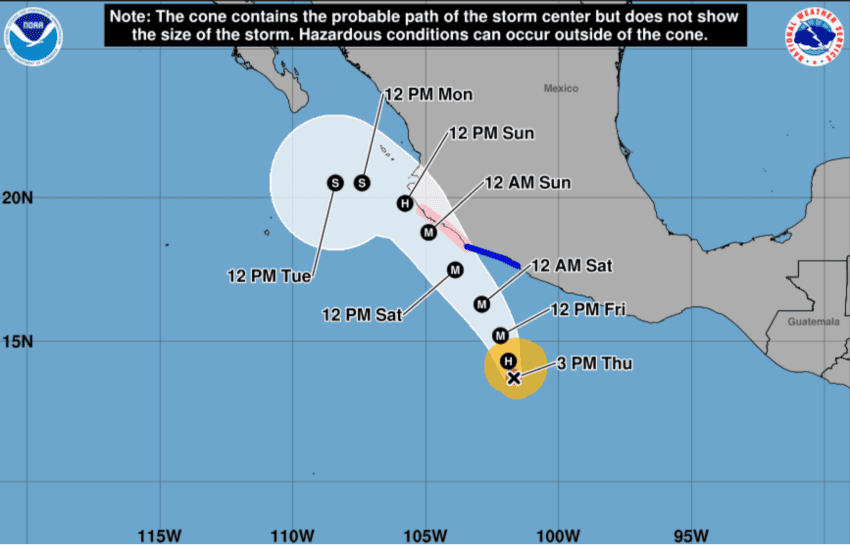
Now comes Trudy, which became a hurricane before dawn Thursday.
The storm system was located about 300 miles (480 kilometers) southwest of Acapulco and 445 miles (720 km) south-southeast of Manzanillo, Colima, while registering maximum sustained winds of 75 mph (120 km/h), with gusts of 93 mph (150 km/h).

According to the U.S. National Hurricane Center (NHC), Trudy is undergoing a period of rapid intensification as it moves northwest at 9 mph (15 km/h) and is expected to bring heavy rains to Oaxaca and Guerrero today (Thursday).
Forecast models project it will become a major hurricane as it approaches the coast of southwestern and west-central Mexico this weekend, bringing rainfall of 4 to 8 inches (101 to 203 millimeters) through the weekend across Colima and Jalisco states.
Meanwhile, Simon remains virtually “frozen” a few hundred kilometers west-southwest of Cabo Corrientes, Jalisco, and is expected to continue orbiting in place with sustained winds of 75 mph (120 km/h) and gusts of 95 mph (150 km/h).
Sustained winds were about 130 miles (210 kilometers) per hour as the week began, and the storm’s inner core was brushing up against the Jalisco coast.
The topography of the Sierra Madre mountains appeared to temper Simon’s intensity and shrink the size of its wind field, the NHC said. Still, as the storm system weakened from a Category 4 to Category 1 it delivered heavy rain and flooding to coastal areas, including the port city of Manzanillo, Colima.
With reports from La Jornada, The Associated Press, El Economista, Meteored and CNN en Español