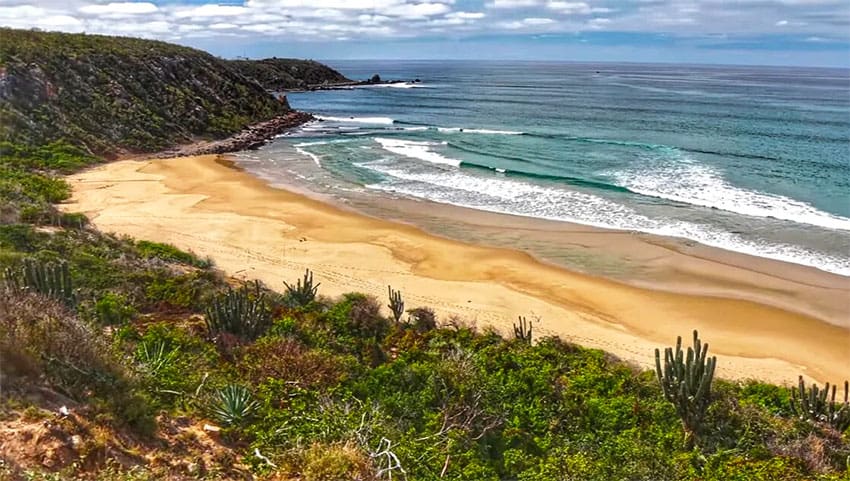
An archipelago of four small islands located 100 kilometers off the coast of Nayarit and about 370 kilometers southeast of the Baja Peninsula was home to prison inmates for 114 years.
But since President Lopez Obrador announced the closing of the Islas Marías penal colony in 2019, biologists are discovering that the tiny archipelago is also home to a vast array of marine life.
Researchers have identified 21 species of sharks, 10 different rays, three species of sea turtles and healthy coral reefs bursting with life.
On land, the yellow-headed parrot, red cardinal, rabbits and raccoons thrive amidst six different ecosystems, said Jorge Castrejón, director of the Islas Marías Biosphere Reserve.
The endangered whale shark swims in the waters off the Marías, as do 114 species of commercial fish, such as sardines, tuna and red snapper.
Little is known about marine mammals, but scientists posit that due to the islands’ location, humpback whales, gray whales, orcas and dolphins should make their way to the reserve, which has been a protected area for the last 20 years. In 2010, the archipelago was also declared a biosphere reserve by UNESCO.
In the past, prisoners were used to implement conservation measures, but Mexico’s National Commission on Protected Areas (Conanp) has taken over since the prison complex was closed.

Twenty 20 park rangers will be sent to live on the largest of the four islands, María Madre, to help conduct biodiversity studies and update the archipelago’s management plan as opening the rugged islands up for fishing and tourism is being contemplated.
“What comes next is to study the sea and make a diagnosis of the real conditions in which the ecosystem is found, and its capacity to sustain fishing activity,” Castrejón said.
Crews will begin working on María Madre to rid it of non-indigenous species such as cats and goats and carry out reforestation efforts.
“In the area where the prisons were located we have to carry out restoration, reforestation and, above all, the reintroduction of some species that, by themselves, find it difficult to grow back.”
The renewed interest in the Islas Marías comes after Lopez Obrador declared that the former prison would be transformed into a cultural center called “Los Muros de Agua,” in homage to the book The Walls of Water written by Mexican author José Revueltas while imprisoned on the island.
Source: Milenio (sp)
CORRECTION: The Islas Marías were incorrectly identified as a UNESCO World Heritage Site in the previous version of this story. In fact, they were declared a biosphere reserve by UNESCO in 2010.