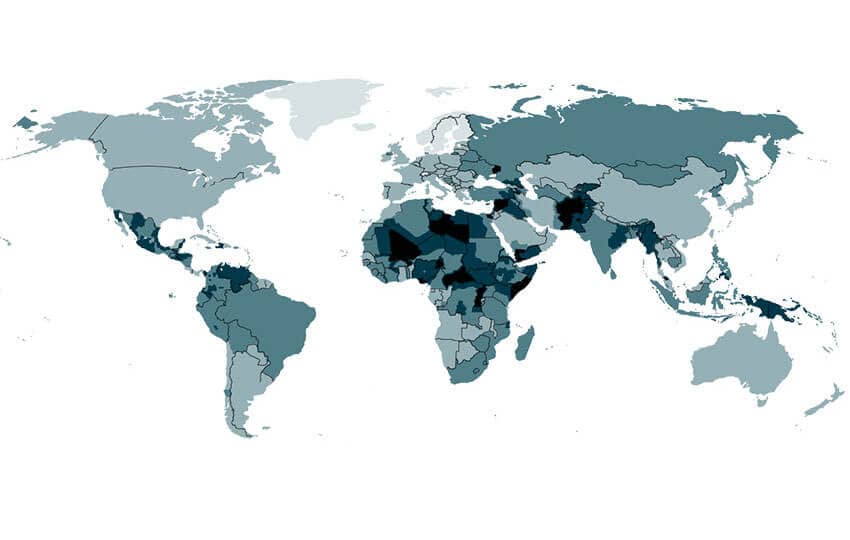
The security risk for business is high in 16 of Mexico’s 32 states, according to a global risk and strategic consulting firm.
Baja California, Chihuahua, Colima, Guanajuato, Guerrero, Jalisco, México state, Michoacán, Morelos, Quintana Roo, Sinaloa, Sonora, Tamaulipas, Tabasco, Veracruz and Zacatecas are rated as high risk on Control Risks’ RiskMap 2022. The map also shows there is a heightened maritime risk off Mexico’s southeastern coast, where pirates have targeted oil platforms.
The firm’s security risk assessment evaluates threats to the financial, physical and human assets of a business, as well as the willingness and capability of public security forces to protect corporate assets and personnel.
It assesses risk factors including military conflict, insurgency, terrorist attacks, strikes and riots, vandalism, kidnapping, and violent and acquisitive crime. The high risk rating is the second highest on the RiskMap after extreme.
A high risk means “the security environment presents persistent and serious challenges for business,” Control Risks said, adding that routine business activities generally require enhanced or specialized security.
The security risk in five states – Aguascalientes, Baja California Sur, Campeche, Querétaro and Yucatán – is considered “low,” meaning that security conditions do not impede normal business. The risk is medium in Mexico’s 11 other states, including Mexico City.
The 16 high risk states include the six most violent, where 50% of all homicides occurred in the first 11 months of last year. They are, in order, Guanajuato, Baja California, Michoacán, México state, Jalisco and Chihuahua. Organized crime groups have a significant presence in all those states, and many others.

Among other countries considered high risk for security are Venezuela, Nigeria, Iraq, Pakistan and Papua New Guinea.
Control Risks’ RiskMap also includes country assessments for political, terrorism, cyber and operational risks.
Political risk in Mexico is medium, meaning that “the political and policy environments are periodically challenging for business.”
Changes and proposed changes to energy sector rules have particularly upset foreign and private companies, especially those that have invested in the generation of renewable energy in Mexico. The federal government’s proposed electricity reform, which would favor the state-owned Federal Electricity Commission over private companies, is creating uncertainty and halting new investment, the European Union’s ambassador to Mexico said last month.
The risk of terrorism in Mexico is low, while the cyber risk for companies is high, meaning that “cyber threats pose persistent and serious challenges for business,” Control Risks said.
The state oil company Pemex, the National Lottery, insurance company AXA and financial institutions including at least three banks have all suffered cyberattacks in recent years.
The fifth and final risk assessed by Control Risks is operational. To calculate it, the firm evaluated the influence of societal and structural factors that either facilitate or impede efficient business operations. Factors assessed include infrastructure; ease of establishing and maintaining a functioning business; ease of recruiting and retaining skilled workers; bureaucratic and business culture; and resilience to natural disasters.
Control Risks concluded that the operational risk in Mexico is medium, meaning that business faces regular operational difficulties, which “occasionally may be serious.”
The firm also looked at the state of democracy in Mexico and the region of which it is part.
In a RiskMap 2022 supplementary article entitled “Democracy is being destroyed in Latin America,” Control Risks said the region is experiencing a wave of authoritarianism and populism that is “eroding and, in some cases, destroying democracy.”
“This will continue in 2022. Companies and investors should plan accordingly,” it said.
“… During the first half of his six-year presidential term, ending in 2024, popular Mexican President Andrés Manuel López Obrador (AMLO) displayed marked authoritarian tendencies. These included concentrating power in the executive (or, more precisely, himself), blatantly disregarding nominally independent regulatory institutions and excessively relying on the military, including beyond its traditional role,” Control Risks said.
“AMLO has hailed his term in office as the ‘Fourth Transformation’. This is his much-vaunted – or much-maligned, depending on whom you ask – transformative project aimed primarily at shaking up the political and business establishment with the laudable if quixotic aim of creating a more equitable society. AMLO will deepen the transformation in 2022 and over the remainder of his term.”
Mexico News Daily