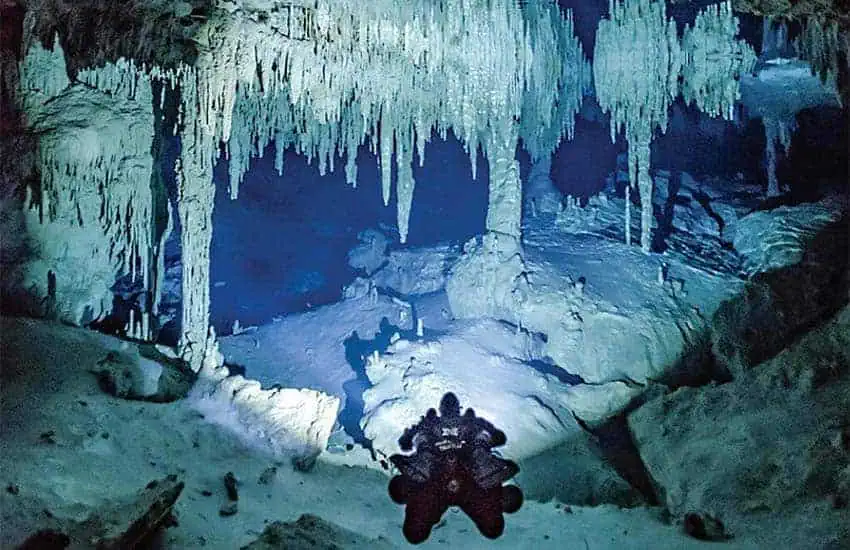
Sac Actun cave system named one of 100 global geological heritage sites

Sac Actun, a 368-km cave system under the Yucatán Península, is one of the world’s 100 most important geological sites according to the International Union of Geological Sciences (IUGS).

The first-ever ranking to compile a database of geological sites of scientific value, the project had the support of UNESCO and seeks to accomplish a worldwide inventory of geological heritage of international relevance.

Sac Actun, the only site in Mexico to have made the list, is the largest underwater cave system in the world and the second largest cave after the Mammoth Cave in Kentucky, United States.

According to the IUGS report, “the extensive cave systems under the Yucatán Peninsula have been a guardian of hidden and invaluable treasures to learn from our history,” and a crucial site to understand how sea level has changed over the past 800,000 years.
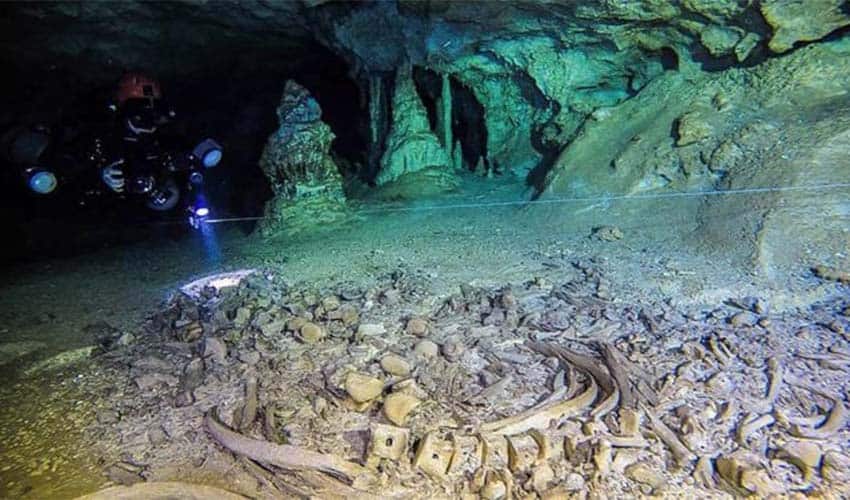
Ancient Maya remains found in the Sac Actun underwater cave system in Quintana Roo
Sac Actun has not only contributed to the advancement of geological science but also in anthropology and paleontology: remains of Pleistocene humans and extinct prehistoric animals have been found there. (Photo: INAH)

According to the IUGS website, “a geological heritage site is a key place with geological elements and/or processes of scientific international relevance,” that have made a major contribution to the development of geological sciences throughout history.

Being underwater, the caves also have created a unique environment for the conservation of human and animal remains, which has led to changes in science’s understanding of human history on the continent. Well-preserved remains of Pleistocene humans and animals dating back thousands of years before the Maya inhabited the area have been discovered there, including the remains of a 13,000 year old adolescent girl.

The importance of the cave system also lies in its ecological value – Sac Actun provides almost all the fresh water used in the area, while also supporting the entire jungle ecosystem above it.

Concerns have been raised about the Maya Train project posing an environmental threat to its surroundings, including Sac Actun, which experts reported in 2018 was among the underwater systems that could be affected by the train’s construction.

With reports from La Jornada Maya and IUGS report

Have something to say? Paid Subscribers get all access to make & read comments.
Manzanillo, Colima, México, 13 de marzo de 2026. La doctora Claudia Sheinbaum Pardo, presidenta Constitucional de los Estados Unidos Mexicanos en conferencia de prensa matutina, “Conferencia del Pueblo” desde Colima. La acompañan Indira Vizcaíno Silva, gobernadora Constitucional del Estado de Colima; Omar García Harfuch, secretario de Seguridad y Protección Ciudadana (SSPC); Raymundo Pedro Morales Ángeles, secretario de Marina (Semar); Bulmaro Juárez Pérez, divulgador de lenguas originarias, presentador de la sección “Suave Patria”; Ricardo Trevilla Trejo, secretario de la Defensa Nacional (Sedena); Jesús Antonio Esteva Medina, secretario de Infraestructura, Comunicaciones y Transportes; Bryant Alejandro García Ramírez, fiscal general del Estado de Colima; Fabián Ricardo Gómez Calcáneo; Rocío Bárcena Molina, subsecretaria de Desarrollo Democrático, Participación Social y Asuntos Religiosos de la Secretaría de Gobernación; Efraín Morales López, director general de la Comisión Nacional del Agua (Conagua); Marcela Figueroa Franco, secretaria ejecutiva del Sistema Nacional de Seguridad Pública (SESNSP) y Guillermo Briseño Lobera, comandante de la Guardia Nacional (GN). Foto: Saúl López / Presidencia

Mexico’s week in review: Congress deals Sheinbaum her first legislative defeat

1
The week of March 9 in Mexico was marked by standoffs between allies in Congress and adversaries at the airport. Here's what you missed.
A soldier displays seized handguns

The US and Mexico, growing together and growing apart: A perspective from our CEO

1
From a historic drop in homicides to opposite bets on electric vehicles, Mexico News Daily's CEO breaks down where the U.S. and Mexico are converging — and where they're not.
Veracruz Gov.

Veracruz governor blames private vessel for 200-kilometer Gulf Coast oil spill

1
The spill, which has spread to over 200 kilometers of Mexico's Gulf Coast beaches, has been traced to a private oil tanker off the coast of Tabasco.
BETA Version - Powered by Perplexity