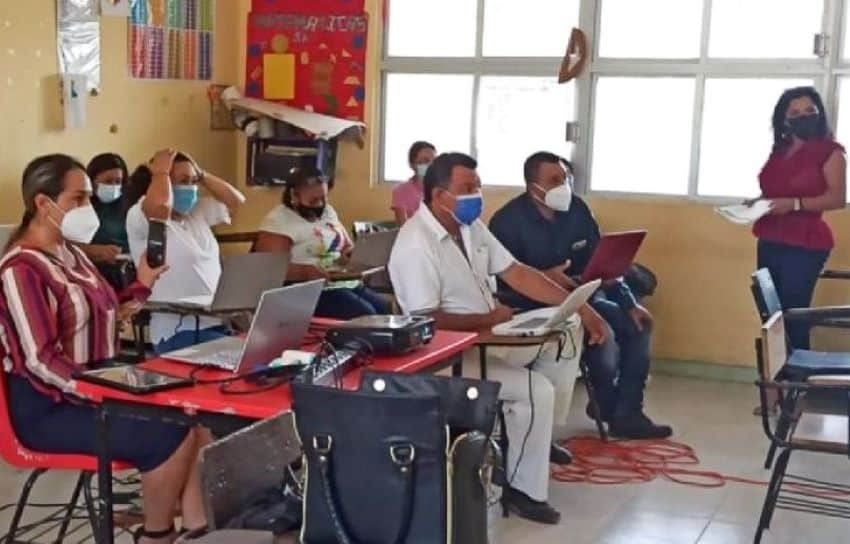
Campeche on Monday became the first state in Mexico to reopen schools more than a year after they closed due to the coronavirus pandemic.
At least 137 public primary schools in rural, largely indigenous communities where poor internet connectivity makes studying online difficult were expected to welcome back some 5,900 students and 278 teachers.
Most teachers in Campeche, one of eight states that are currently low-risk green on the federal government’s coronavirus stoplight map, have received at least one dose of a Covid-19 vaccine, but the decision to reopen schools nevertheless encountered some resistance.
The SNTE teachers union said that schools shouldn’t reopen until teachers have received both required vaccine doses and authorities can guarantee that appropriate virus mitigation measures are in place.
Miguel Augusto Palomo Cuevas, principal of a school in a rural community in the municipality of Carmen, said the state Education Ministry pledged to provide cleaning materials after the Easter vacation period but hasn’t met that commitment.
Palomo told the newspaper El Universal that it would be preferable to wait until the start of the 2021–2022 academic year, which will begin in August, because there is a lot of movement between Campeche and the neighboring states of Yucatán and Tabasco, neither of which is green on the stoplight map.
(Yucatán is currently high-risk orange while Tabasco is medium-risk yellow.).

“… I live in Mérida and work in Campeche,” Palomo said, adding that some other education workers travel from Yucatán and Tabasco for work.
Leonel Obed Dzul Canul, a Campeche teacher, said that he and his colleagues are keen to get back to school but agreed that the authorities must guarantee that teachers and students will be safe.
For his part, Campeche Education Minister Ricardo Koh Cambranis said that all the schools that are reopening were cleaned last week. He noted that not all students will go to school on the same days, explaining that half will attend one day and the other half the next day.
Koh said the Education Ministry will monitor the situation in the 137 schools over the next three weeks and if there is no evidence of the virus spreading, an additional 486 preschools, primary schools and middle schools will welcome back students in a second phase of the resumption of in-person classes. Private schools won’t reopen until a third phase, he said.
Campeche is Mexico’s least affected state in terms of both confirmed coronavirus cases and Covid-19 deaths. As of Sunday, the gulf coast state had recorded 9,193 of the former and 1,141 of the latter.
Source: El Universal (sp)