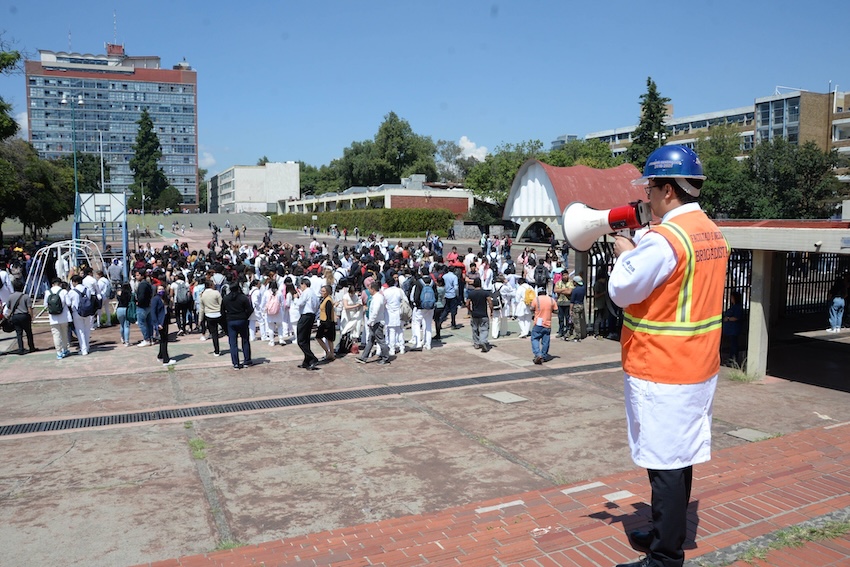
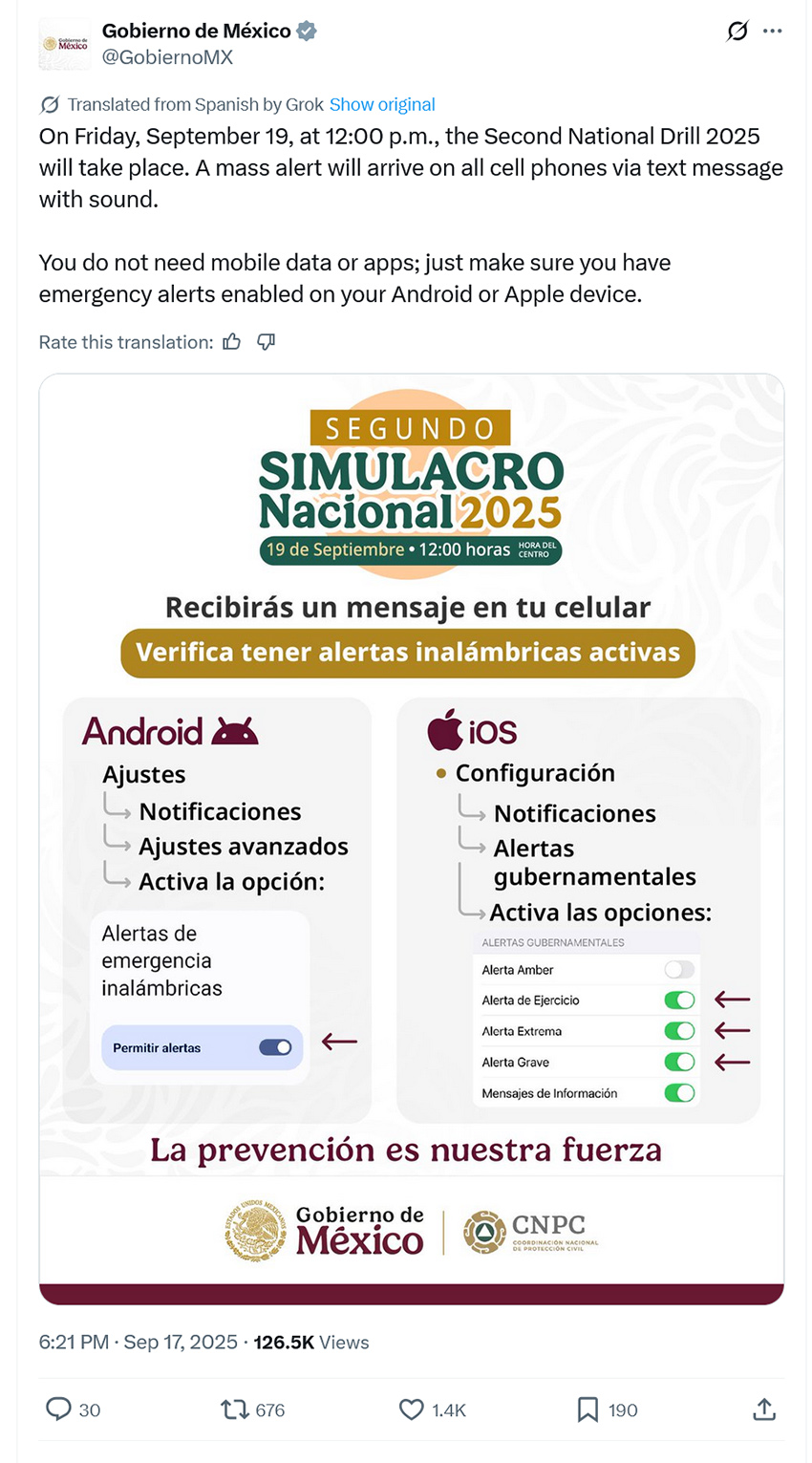
More than 80 million cell phone users in Mexico should expect to receive an alert at noon on Friday as a signal to participate in the government’s twice-annual earthquake drill, which will also include emergency exercises for several types of natural disasters, depending on the region of the country.
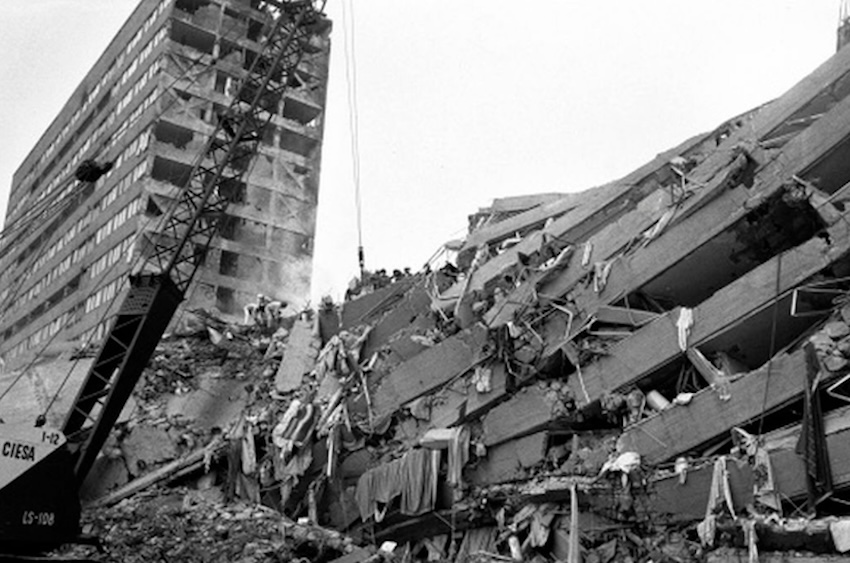
Friday’s drill, the second this year, falls on the 40th anniversary of the devastating Sept. 19, 1985, earthquake that claimed the lives of untold thousands. That 8.1-magnitude temblor was followed by an aftershock the next day that heightened the damage.
The drill also falls on the eighth anniversary of the 7.1 magnitude quake that killed more than 350 people and heightened the notion among Mexicans that September is earthquake month.
However, since not all states are equally vulnerable to seismic events, the type of drill will vary by location.
The hypothesis for central Mexico, including Mexico City, will be an 8.1-magnitude earthquake with its epicenter in Lázaro Cárdenas, Michoacán, on the Pacific Coast. The simulation will be for an intense quake in Mexico City, Guerrero and Michoacán; a strong or very strong one in Colima, Oaxaca, Morelos and México State; and a moderate temblor in Guanajuato, Puebla, Tlaxcala and Veracruz.
In the states of Campeche, Yucatán, Sonora, Quintana Roo and Baja California Sur, the hypothetical emergency will be a hurricane.
In the states of Durango, Guanajuato and Tamaulipas, it will be an urban fire, while Baja California residents simulate a reaction to a tsunami.

Who participates in the drills?
Local governments will join the federal government in carrying out Friday’s drill, which will ask civil protection and security agencies as well as emergency responders and everyday residents to react to the hypothetical natural disasters.
The federal government will also test its cell phone alert system, announcing on Tuesday that it hopes to send a warning to cell phones in every corner of the country. During last year’s September drill, the alert system was tested only in the greater Mexico City area.
Local governments have been preparing for the drill for several months. The Mexico City drill preparations included a request that building managers/owners register with City Hall and submit participation results and observations afterward. More than 9 million people have signed up as formal participants, and 126,000 buildings are registered.
Community organizations were advised of the hypothetical disaster for their region and asked to confirm evacuation plans, discuss and prepare protocol and ensure that emergency contact information is up to date.
What should you do during the drill?
The drill will begin at 12 noon Mexico City time and all 32 federal entities (31 states and Mexico City) will participate.
In a press release describing the drill at length, the government said the earthquake siren will ring out from 14,491 loudspeakers (primarily located in Mexico City), while alerts will be issued by 100 AM/FM commercial radio stations, as well as 11 public TV stations. Cell phones should start pinging at the same time.
The public is asked to participate by evacuating buildings and obeying instructions of safety representatives.
Participants should also assist and look after children, the elderly and people with disabilities.
They should also turn off gas, water and electricity as they would in a real emergency. With this in mind, the public should consider family civil protection plans and consciously identify safe areas in homes, schools and workplaces.
Since emergency response protocols will be activated and municipal, state and federal authorities will use the drill to test emergency response strategies, the public is asked to remain calm and allow responders to carry out their exercises.
With reports from El Economista and El Financiero