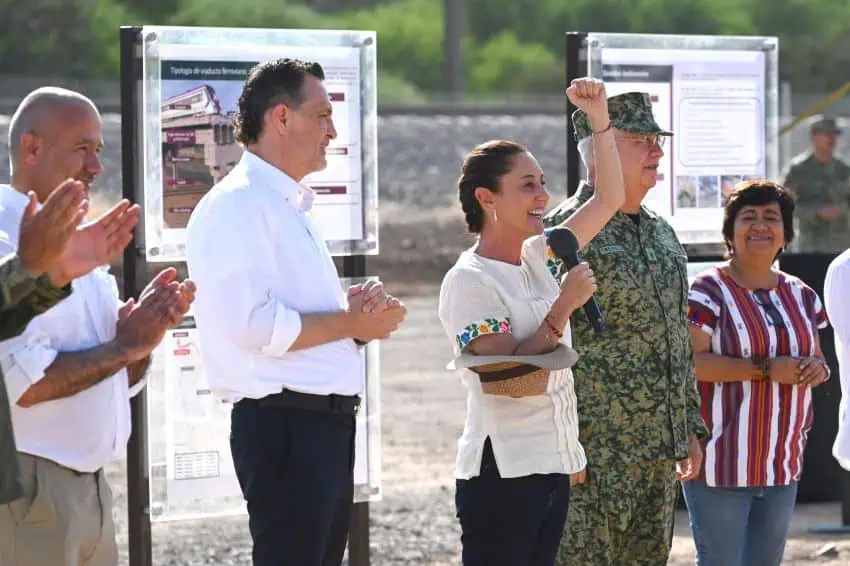
President Claudia Sheinbaum on Sunday formally inaugurated the Mexico City-Querétaro train project, a 226-km-long route connecting Mexico’s capital with a city and state that have experienced dynamic economic growth in recent years.
At a ceremony 30 kilometers outside Querétaro city, Sheinbaum said construction will cost an estimated 167 billion pesos (US $8.5 billion).
Upon announcing the project in October, authorities had estimated a cost of 75 billion pesos (US $3.75 billion). Cost estimates rose, project engineers said, after determining it will be necessary to build six tunnels, 14 elevated aqueducts, 28 underpasses and 52 overpasses.
The Defense Ministry is charged with completing the project in two-and-a-half years.
“My commitment is to complete the route before [Governor Mauricio Kuri’s] term ends,” Sheinbaum said. Kuri, a member of the opposition National Action Party, will be in office until Sept. 30, 2027.
Sheinbaum expressed confidence in the military’s ability to meet the deadline, saying “there’s nobody more capable.” She also emphasized that using the military will keep the train in public hands.
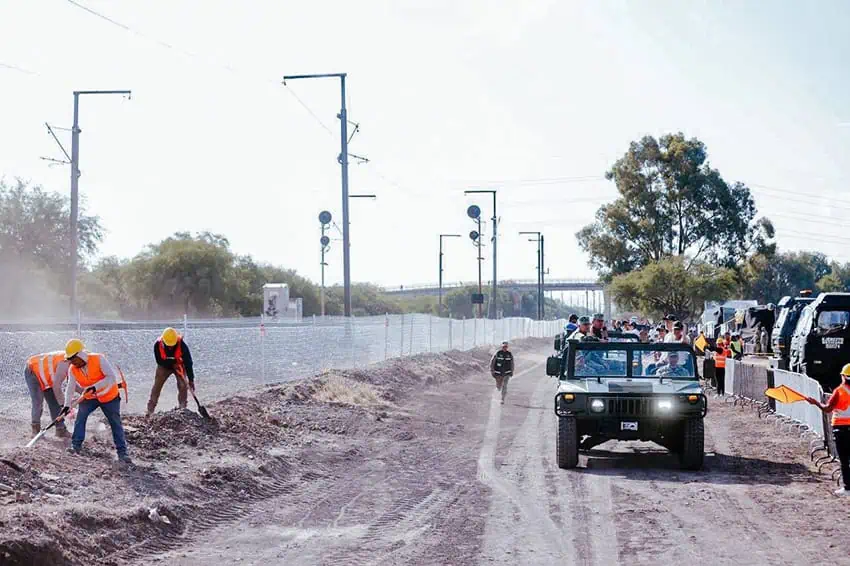
General and army engineer Gustavo Ricardo Vallejo, who oversaw construction of the Felipe Ángeles International Airport, said his men will be working 24-7.

“It is in our best interest to finish the project on time, efficiently and flawlessly,” Vallejo said.
The proposed timeline is assisted by the fact that the route will largely rely on existing freight train tracks. Military engineers will focus on smoothing out curves and addressing vertical divergences, allowing the train to reach speeds of 160-200 km/h.
During remarks at the ceremony, Governor Kuri thanked Sheinbaum, recalling that a Mexico City-Querétaro train had been under consideration by several previous administrations, none of whom had moved beyond vague proposals.
In a social media post, Kuri called the project “a reflection of the shared vision and commitment to the development of our state and our country, boosting communications, investment, and employment.”
Marco del Prete, Querétaro’s minister of social development, said the train will be an engine of growth for thousands of families. In a social media post of his own, del Prete also said the route will have stations in Mexico City; Huehuetoca, México state; Tula, Hidalgo; San Juan del Río, Querétaro; and two stations in Querétaro city.
Hoy inicia una obra histórica: el tren México-Querétaro, un proyecto que conectará regiones, impulsará la movilidad eficiente y generará más de 600 mil empleos directos e indirectos. Con estaciones en Huehuetoca, Tula, San Juan del Río y Querétaro. Este tren será un motor de… pic.twitter.com/B59FKpg6uq
— Marco Del Prete (@mdelprete) April 28, 2025
“[This] historic project … will connect regions, boost efficient mobility, and generate more than 600,000 direct and indirect jobs,” del Prete wrote.
Sheinbaum announced that the terminal in Querétaro city will be called “La Corregidora,” an homage to Josefa Ortiz de Domínguez, a heroine of the Mexican independence movement.
The president also reiterated her promise to build more than 3,000 kilometers of railway track for passenger trains.
As part of the goal to extend passenger train routes to the north of the country, the Querétaro station will eventually link to the border city of Nuevo Laredo, Tamaulipas, in the northeast, and connect to the northwestern border city of Nogales, Sonora.
“Querétaro will become a railroad hub,” Sheinbaum said. “Trains connecting to the Pacific and Gulf coasts will depart from here.”
Sunday’s ceremony occurred just five weeks after Sheinbaum inaugurated the Mexico City-Pachuca train project.
With reports from El Economista, La Jornada and Eje Central