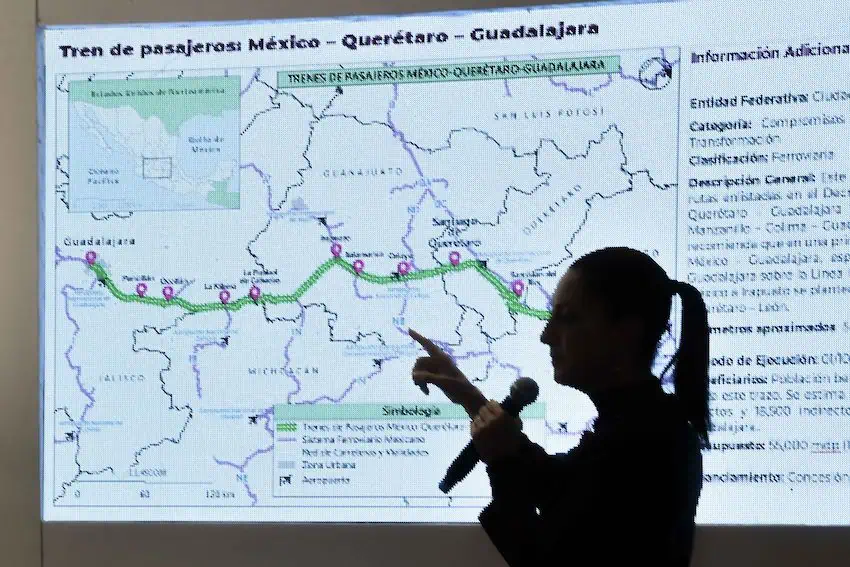
On Wednesday, President-elect Claudia Sheinbaum unveiled her plans to build — not one, but three — new passenger train routes in Mexico based on the model of the Maya Train, which used a combination of public and private investment.
These three lines will connect Mexico City with Nuevo Laredo, Mexico City with Guadalajara and the Felipe Ángeles International Airport (AIFA) with Pachuca.
At a press conference on Monday, Sheinbaum confirmed her interest in developing new train routes, building on President Andrés Manuel López Obrador’s commitment to revive passenger trains across the country.
Speaking on Wednesday, the president-elect provided further details of her plans, detailing which routes she will seek to develop and the public tender timeline.
For two of the three routes, the passenger lines will seek to use the same rights of way currently used by private freight operators. Existing tracks will be rehabilitated or new tracks will be laid along freight lines to accommodate the passage of both.
So far, three international firms have shown interest in the public tender to build the train cars: French Alstom, Spanish Construcciones y Auxiliar de Ferrocarriles (CAF) and Chinese CRRC Zhuzhou Locomotive.
The new passenger train routes
Mexico City to Nuevo Laredo

On Monday, Sheinbaum announced a new passenger route passing through eight states, starting in Mexico City and ending in the border city of Nuevo Laredo. Construction on the route is scheduled to begin in October and will be completed in December 2029, Sheinbaum said.
Mexico City to Guadalajara
This train would connect Mexico City with the western city of Guadalajara, Jalisco. Sheinbaum said this line could be extended to the border city of Nogales, Sonora. Construction is also expected to begin in October and finish in May 2029.
This route will pass through Mexico City, Hidalgo, Querétaro, Guanajuato and Jalisco, covering 581 kilometers of railway.
AIFA to Pachuca
This route will connect the Felipe Ángeles International Airport (AIFA) in México state with Pachuca, Hidalgo.
The first part of this train, which connects Buenavista station in Mexico City with the AIFA, is on track to be completed before the end of López Obrador’s term in September, as announced by the president at a press conference in May.
AIFA-Pachuca, like Buenavista-AIFA, will require new tracks to be laid.
Mexico’s railway sector is “all aboard”
The head of the Mexican Railway Association (AMF), Óscar del Cueto, celebrated Sheinbaum’s announcement.
In an interview with the newspaper El Economista, del Cueto said that planning three train lines — instead of the eight routes originally proposed during Sheinbaum’s campaign — shows a well-structured start for her government. However, he said that completing the routes in five years depends on the successful negotiation of right of way, which implies a complex analysis.
Members of the AMF — including Canadian Pacific Kansas City — have carried out several technical studies to analyze the feasibility of new train projects.
With reports from Milenio, El Economista, CNN, El Financiero, and Proceso