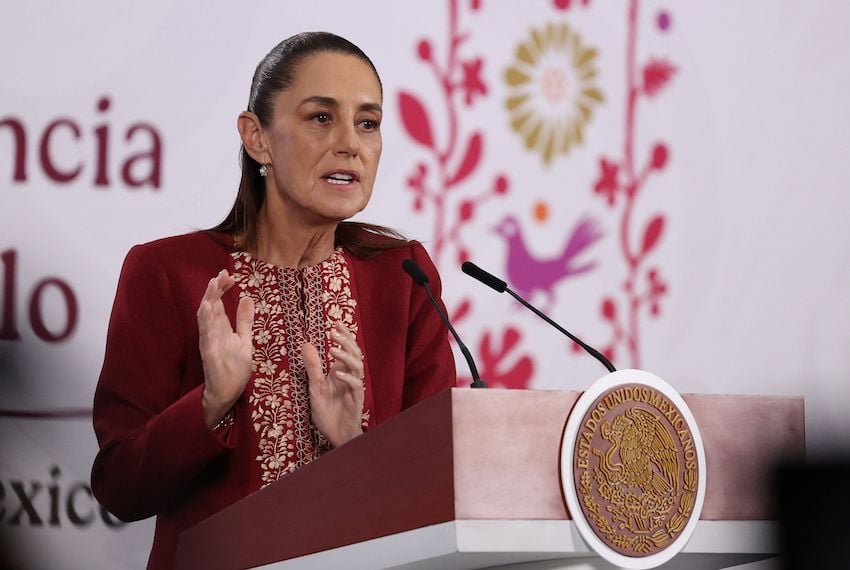
President Claudia Sheinbaum on Tuesday reiterated her government’s rejection of a report by a United Nations committee that concluded that there are “well-founded indications” that enforced disappearances have been and continue to be committed as crimes against humanity in Mexico.
At her morning press conference, Sheinbaum asserted that the aim of the report by the UN Committee on Enforced Disappearances (CED) is “essentially to criticize the government of Mexico” rather than present an accurate portrayal of the missing persons problem.
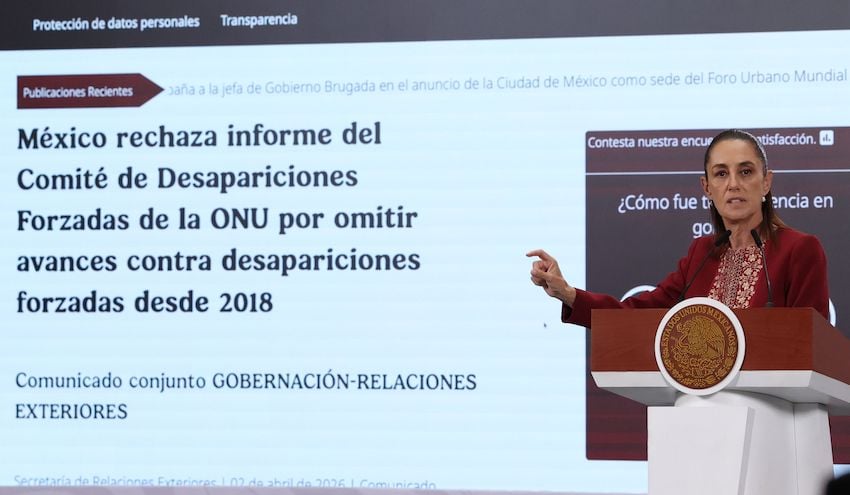
The UN announced last Thursday that the CED had “decided to request the UN Secretary-General to urgently refer the situation of enforced disappearances in Mexico to the UN General Assembly for consideration of measures to support the State Party [i.e., Mexico] in preventing, investigating, punishing and eradicating this crime.”
According to the United Nations’ own definition, “an enforced disappearance is considered to be the arrest, detention, abduction or any other form of deprivation of liberty by agents of the State or by persons or groups of persons acting with the authorization, support or acquiescence of the State.”
Sheinbaum’s remarks on Tuesday came after her administration issued a statement last Thursday that said that “Mexico rejects the Committee’s report as biased and dismissive of the observations, analysis, and updates submitted by the Mexican Government.”
The statement also said that “the report primarily addresses events from 2009 to 2017 — under the administrations of Felipe Calderón and Enrique Peña Nieto — and is limited to four states.”
In addition, it stated that “the Mexican Government does not tolerate, permit, or order enforced disappearances” and “has pursued legislative and institutional reform, in coordination with families’ collectives, to address this scourge.”

Human rights activists and relatives of the disappeared promptly condemned the government’s response, demanding that it accept international aid to face a crisis that has resulted in more than 132,400 missing persons in Mexico, more than 4,500 clandestine graves and nearly 72,000 unidentified human remains.
Sheinbaum: Enforced disappearances ‘no longer occur in Mexico’
On Tuesday morning, a reporter asked the president about the response of CED president Juan Pablo Albán to Mexico’s rejection of the CED report.
In a lengthy social media post on Monday, Albán wrote that the CED’s analysis of enforced disappearances in Mexico is “not limited” to a specific period but rather “examines the evolution of the situation up to the present day.”
En el debate público reciente sobre la decisión adoptada por el Comité contra la Desaparición Forzada #CED @UNTreatyBodies bajo el artículo 34 de la Convención Internacional para la Protección de Todas las Personas contra las Desapariciones Forzadas, considero importante aportar…
— Juan Pablo Albán (@JuanPablo_Alban) April 6, 2026
Among various other points, he said that Mexico’s disagreement with the CED’s findings is “legitimate,” but its condemnation (or disqualification) of the committee’s report is “questionable.”
Among various declarations on Tuesday morning, Sheinbaum said that:
- The CED used an analysis of enforced disappearances from 2009 to 2017 in four states “to extrapolate up to 2025.”
- The CED didn’t take into account “several observations” that the Ministry of Foreign Affairs and the Interior Ministry made in response to a draft of the committee’s report that they were sent.
- Enforced disappearances “no longer occur in Mexico.”
- No government institution gives orders for people to be abducted.
- The government is working to combat — and “wants to eradicate” — abductions committed by organized crime groups.
- The government has “developed and approved new laws” aimed at combating abductions.
- The government is “helping to search” for all people reported as missing in Mexico.
- It is unjust for the CED to “equate” abductions committed by organized crime groups to enforced disappearances.
- The CED itself highlighted that “it found no evidence of a federal policy to commit enforced disappearances.”
- The CED “is not recognizing the effort” the Mexican government is making to combat the crime of abductions and locate missing persons.
- The aim of the CED report is “essentially to criticize the government of Mexico.”
- The CED report has “a lot of weaknesses.”
Sheinbaum said that federal officials and “human rights experts” would hold a press conference to explain in more detail why her government rejects the CED report.
“We can bring experts if you like … so that they clearly say what the [content] in this document means and why the government is rejecting it,” she said.
Sheinbaum — who has said that “attending to the problem of missing persons” is a “national priority” for her government — also posed a number of questions to the CED. Among them:
- “Why is there no recognition that a search commission was established [in 2018]?”
- “Why don’t they acknowledge everything the Mexican government has done [to combat abductions] and its firm commitment to keep making progress on this issue?”
- “Why do they want to take [the issue] to the United Nations [General] Assembly?”
- “Why don’t they recognize the difference between one form of disappearance and another?”
- “Why don’t they recognize that the Interior Ministry meets with [search] collectives once a week, once a fortnight?”
- “Why don’t they recognize the number of searches they have been carried out in the country?”
Sheinbaum asserted that there is “no recognition” of anything the Mexican government has been doing to respond to the missing persons crisis.
Sheinbaum rejected a suggestion that the Mexican state is “overwhelmed” by the situation of disappearances, asserting that it is acting in response to a “phenomenon” that “arose” (or, more accurately, worsened) after former president Felipe Calderón launched a militarized war on drug cartels shortly after he took office in late 2006.
Mexico News Daily