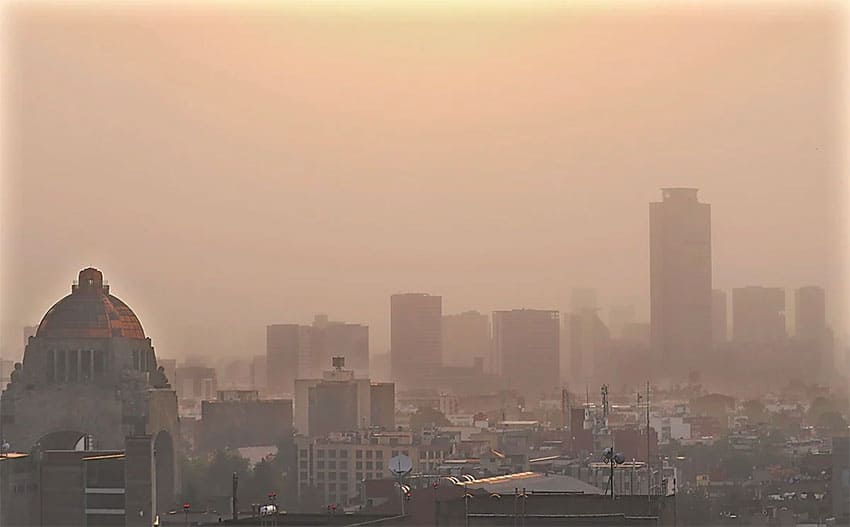
Dust clouds and 25-kilometer-per-hour wind gusts Sunday caused a part of Mexico City to register one of the city’s highest levels of small-particle pollution in years, almost six times the acceptable limit.
The city’s air monitoring agency did not declare an official pollution alert, nor were instructions issued for citizens not to drive. But the agency did warn about high winds which appear to have kicked up enough particulate matter into the air to cause the southern Iztapalapa borough to record PM10 levels at 581 points.
On the air monitoring scale, 100 points is considered the highest safe level.
While winds in the city had died down to around 10 kilometers per hour Monday an update by the agency around 2:30 p.m. continued to list the borough’s air quality to be at “high risk” to health.
The rest of the city was listed as “acceptable” or “good.”
According to the federal water agency Conagua, the high winds were caused by cold front No. 46.
PM10 particles often result from dust or soil being dispersed in the air at construction sites, landfills, and on farm land. It also can occur due to wildfires and brush and waste burning.

It is currently brush-burning season in the city. In addition, according to the nation’s forestry service, Conafor, Mexico City experienced 41 forest fires between March 19 and March 25 and is one of the country’s top 10 states for the greatest number of forest fires so far in 2021.
Ozone and very small particles, known as PM2.5, can be caused by vehicle emissions and typically cause more of Mexico City’s pollution problems, but they did not appear to be the culprit in Sunday’s spike.
Source: Associated Press (en)