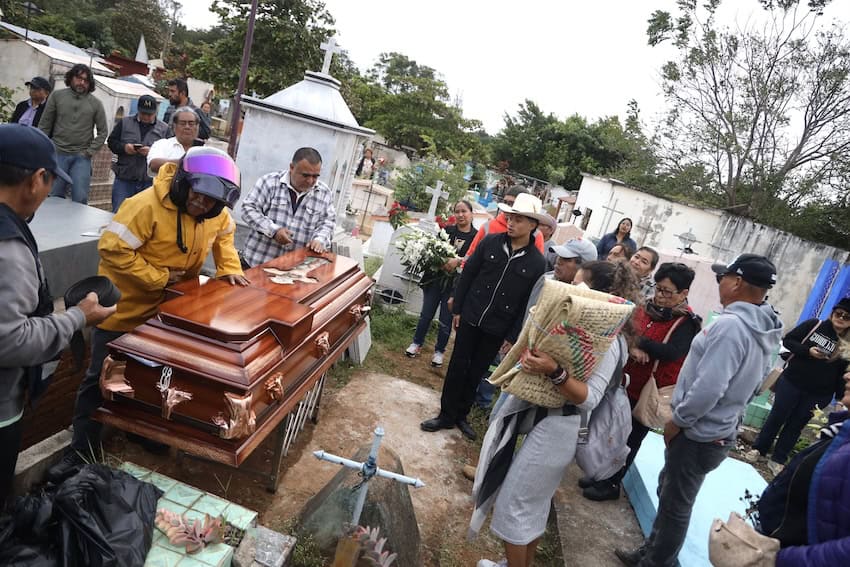
Investigators continue to examine the scene of the tragic Interoceanic Train crash that killed 13 people on Sunday, while Mexico’s government announced it will seek international certification to improve safety on the railway line.
Several questions remain unanswered, even though the authorities are in possession of the train’s black box, which holds the key to understanding the incident. The accident occurred nearly 90 minutes after the six-car Z-line train departed from Salina Cruz, Oaxaca, en route to Coatzacoalcos, Veracruz.

In a statement, the government said 13 experts are on site, working to determine the cause of the accident, which took place on the edge of a ravine on a curved section of track.
The train’s two locomotives managed to avoid falling down the embankment, but the first passenger car became detached and slid approximately 6.5 meters (21 feet) down the slope. The second car was left partially suspended in mid-air, while the third and fourth cars came to rest crosswise over the tracks but were undamaged.
The government is said to be considering asking external experts to assist in the investigation. The Federal Attorney General’s Office (FGR) will ultimately make that decision.
The Naval Ministry — which operates the railway — and the FGR are looking for specialists who can make the necessary recommendations to improve the safety of the megaproject inaugurated just two years ago.
“We’re going to look for the best certification body so that, if they make recommendations on what needs to be done about these curves or … to make the route safer, we can take them into account,” President Claudia Sheinbaum said.

“In other words, once the report is submitted, a certifying body should come to guarantee that the track and locomotives are in good working order and that the train can operate again,” she said.
Sunday’s accident has increased pressure on Sheinbaum over the safety of recent government megaprojects, as this is the third train accident in Mexico this year.
The new Maya Train in the Yucatán Peninsula has experienced two derailments, though nobody was seriously hurt in either.
According to investigative journalist Alejandra Crail, Mexico’s federal auditing agency (ASF) cited “deficient planning” in its inspection of the Interoceanic Train project during construction.
Crail cited a 2019 ASF document detailing technical omissions by the contractors and concerns about their technical capacity to deal with the geography of the area.
Crail told Aristegui Noticias that among the issues mentioned in the ASF report are “steep slopes and curves in the predominantly mountainous areas” through which the train travels, as well as “undulations in the terrain and natural obstacles that affect the alignment of the track.”
The ASF reportedly recommended sanctions for the public officials who allowed the works to continue despite the detected deficiencies. Crail said it is unclear whether these irregularities were corrected in subsequent contracts.
The newspaper Reforma also mentioned the train’s deficiencies, reporting that “the project was plagued by flaws and carelessness” during the construction and track rehabilitation phases, adding that it operates with old and recycled trains, some of which are 50 years old.
Reuters news agency said the project “faced multiple allegations of corruption, weak oversight and potential conflicts of interest.”
With reports from Reuters, Los Angeles Times, El País, Milenio and Aristegui Noticias